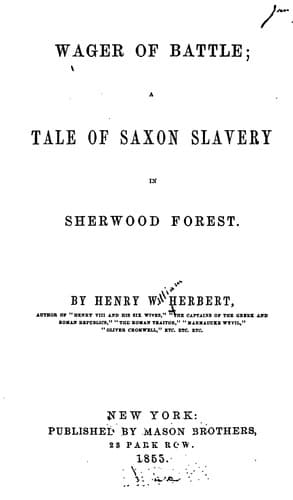
Wager of Battle: A Tale of Saxon Slavery in Sherwood ForestHerbert, Henry William
History
Wager of Battle: A Tale of Saxon Slavery in Sherwood Forest
Herbert, Henry William
Anglo-Saxons -- Fiction; Great Britain -- History -- Norman period, 1066-1154 -- Fiction; Sherwood Forest (England) -- Fiction
Glass windows were unknown in those days, save to the castellated
mansions of the great, or the noble minsters and cathedrals of the
great cities--the art having been first introduced, after the
commencement of the dark ages, in the reign of Edward the Confessor,
although it must have been well known and of common occurrence in
England during its occupation by the Romans, who used glass for
windows as well as implements so early as the time of Cicero, and who
would seem to have brought its manufacture to a perfection
unattainable by us moderns, since it is credibly asserted that they
had the art to render it malleable. Horn and talc, or oiled parchment,
were used by the middle classes, but this was a luxury confined to the
dwellers in towns; and the square mullioned apertures, which here
served for windows, were closed by day and in fine weather by slender
lattices, and during storms or at night by wooden shutters. The want
of these luxuries, however, being unknown, was unregarded; and the
verdurer's house at Kentmere was regarded in those days as a fine
specimen of rural architecture, and stood as high by comparison as
many an esquire's hall of the present day.
For the rest, it was partly overrun with ivy and woodbine, and was
overhung at the western end by a noble mountain-ash, from under the
roots of which welled out a small crystal spring, and sheltered to the
east by a group of picturesque Scotch firs. An out-building or two, a
stone barn, a cow-house, and what, by the baying and din of hounds,
was clearly a dog-kennel, stood a little way aloof, under the skirts
of the coppice, and completed the appurtenances of what was then
deemed a very perfect dwelling for a small rural proprietor, and would
be held now a very tolerable mountain farm-house for a tenant cotter.
This was the new home of Kenric and Edith, now by the good offices of
the old curate of Bowness made man and wife; and here, with the good
old mother nodding and knitting by the hearth, and two stout boys,
Kenric's varlets, to tend the hounds and hawks, and to do the offices
of the small hill farm, they dwelt as happy as the day; he occupying
the responsible position of head-forester of upper Kentdale, and
warder of the cotters, shepherds, and verdurers, whose cottages were
scattered in the woods and over the hill-sides, and both secure in the
favor of their lovely lady, and proud of the confidence of their lord.
CHAPTER XV.
THE OLD HOME.
"Your knight for his lady pricks forth in career,
And is brought home at even-song, pricked through with a spear."
IVANHOE.
That was a dark day for Eadwulf, on which the train of Sir Yvo de
Taillebois departed from the tower of Waltheofstow; and thenceforth
the discontented, dark-spirited man became darker, more morose and
gloomy, until his temper had got to such a pass that he was shunned
and avoided by every one, even of his own fellows.
Public-domain text, read in full here on John Shaqi.
Reviews
Reviews
No reviews yet
Be the first to share your thoughts on this work.
Elsewhere in the archive
Join the Discussion
Join the discussion
Sign in to leave a comment or review.
Sign InorCreate an account