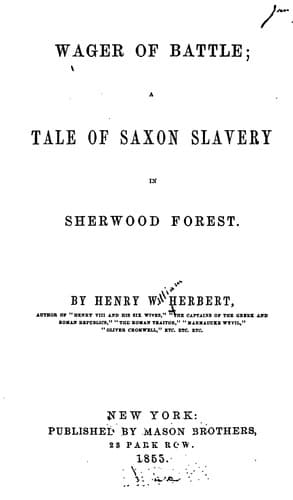
Wager of Battle: A Tale of Saxon Slavery in Sherwood ForestHerbert, Henry William
History
Wager of Battle: A Tale of Saxon Slavery in Sherwood Forest
Herbert, Henry William
Anglo-Saxons -- Fiction; Great Britain -- History -- Norman period, 1066-1154 -- Fiction; Sherwood Forest (England) -- Fiction
It is true, that in the condition of slavery, in the being one of a
despised and a detested caste, in being compelled to labor for the
benefit of others than himself, in the being liable at any moment to
be sold, together with the glebe to which he is attached for life,
like the ox or ass with which he toils as a companion, there is not
much to promote contentedness, to foster a quiet, placable, and gentle
disposition, to render any man more just, or grateful, or forbearing
to his fellows. Least of all is it so, where there is in the slave
just enough of knowledge, of civilization, of higher nurture, to
enable him to desire freedom in the abstract, to pine for it as a
right denied, and to hate those by whom he is deprived of it, without
comprehending its real value, or in the least appreciating either the
privileges which it confers or the duties which it imposes on the
freeman--least of all, when the man has from nature received a
churlish, gloomy, sullen temperament, such as would be likely to make
to itself a fanciful adversity out of actual prosperity, to resent all
opposition to its slightest wish as an injury, and to envy, almost to
the length of hating, every one more fortunate than himself.
It may, however, as all other conditions of inferiority, of sorrow, or
of suffering, be rendered lighter and more tolerable by the mode of
bearing it. Not that one would desire to see any man, whether reduced
by circumstances to that condition, or held to it from his birth, so
far reduced to a tame and senseless submission as to accept it as his
natural state, or to endure it apathetically, without an effort at
raising himself to his proper position in the scale of humanity and
nature.
It is perfectly consistent with the utmost abhorrence of the
condition, and the most thorough determination to escape from it by
any means lawful to a Christian, to endure what is unavoidable, and to
do that which must be done, bravely, patiently, well, and therefore
nobly.
But it was not in the nature of Eadwulf to take either part. His
rugged, stubborn, animal character, was as little capable of forming
any scheme for his own prospective liberation, to which energy, and a
firm, far-reaching will, should be the agents, as it was either to
endure patiently or to labor well.
Perpetually remiss, working reluctantly and badly, ever a recusant, a
recreant, a sullen and morose grumbler, while he in no respect
lightened, but, it is probable, rather enhanced his difficulties, he
detracted from what slight hope there might exist of his future
emancipation, by carefully, as it would seem, conciliating the
ill-opinion and ill-will of all men, whether his equals or his
superiors--while he entirely neglected to earn or amass such small
sums as might be within his reach, and as might perhaps, in the end,
suffice to purchase his liberation.
Public-domain text, read in full here on John Shaqi.
Reviews
Reviews
No reviews yet
Be the first to share your thoughts on this work.
Elsewhere in the archive
Join the Discussion
Join the discussion
Sign in to leave a comment or review.
Sign InorCreate an account