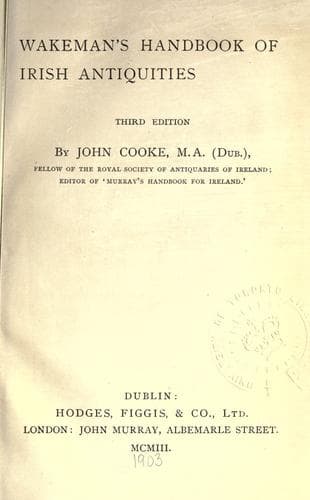
Wakeman's handbook of Irish antiquitiesWakeman, W. F. (William Frederick)
History
Wakeman's handbook of Irish antiquities
Wakeman, W. F. (William Frederick)
Ireland -- Antiquities
On the south coast of Inishmore, the largest of the Aran Islands, is
_Dun Ængus_, described by Petrie as ‘the most magnificent barbaric
monument now extant in Europe.’ It is built on the very edge of sheer
cliffs 250 to 300 feet in height, forming the south and east sides;
it is of a horse-shoe shape, and some archæologists think that it was
originally oval, and that it acquired its present form from the falling
of portions of the cliffs. It consists of three enclosures, and remains
of a fourth. The wall which surrounds the innermost is 18 feet high and
12 feet 9 inches thick; it is in three sections--the inner 7 feet high,
with ranges of steps similar to those in Staigue fort. This enclosure
measures 150 feet from north to south, and 140 feet from east to west.
The doorway is 4 feet 8 inches high, and 3 feet 5 inches wide, very
slightly inclining; and the lintel is 5 feet 10 inches long. In the
north-west side is a passage leading into the body of the wall. The
second rampart, which is not concentric, encloses a space about 400
feet by 300 feet. Outside the second wall is a _chevaux-de-frise_,
30 feet wide, formed by sharp stones placed on end, seemingly to
hinder the approach of an enemy. Surrounding all is a rampart, nearly
destroyed, enclosing a space of 11 acres. Of the same class are Dubh
Caher, Dun Onaght, and Dun Eochla, and on Inishmaan Dun Conor.
* * * * *
_The Dingle Forts._--For variety and profusion of prehistoric and
early Christian remains, that district of Corkaguiny lying west of
a line from Dingle to the north-east entrance of Smerwick Harbour,
has no equal in the British Isles. Scattered over its surface is an
extraordinary number of cashels, clochauns, pillar-stones, early
churches, crosses, and other remains. The fine fortification of
_Ballyheabought_, two miles north of Dingle, consists of a stone-faced
earthen rampart 12 to 14 feet thick, enclosing an area of about 100
feet in diameter, with a continuous narrow platform about 3 feet above
the present level of the court. It is surrounded by a fosse 25 feet
in width, the greatest depth being 20 feet. Beyond this is another
breastwork, 10 feet thick, faced on the exterior with stones, with
a second but smaller fosse without. The entrance was from the west;
and the remains show that a massive stone doorway once existed in the
ramparts. In the inner area are the remains of several clochauns;
the principal one is 18 feet internal diameter; a portion is cut off
into a separate chamber; and a low passage connects this with a small
semicircular compartment to the south. Without the group to the north
is a row of upright flagstones forming a passage to a round oblong
clochaun to the west. A wall to the south connects the circular group
with the rampart, thus shutting off what was probably the women’s
portion of the fort.
Public-domain text, read in full here on John Shaqi.
Reviews
Reviews
No reviews yet
Be the first to share your thoughts on this work.
Elsewhere in the archive
Join the Discussion
Join the discussion
Sign in to leave a comment or review.
Sign InorCreate an account