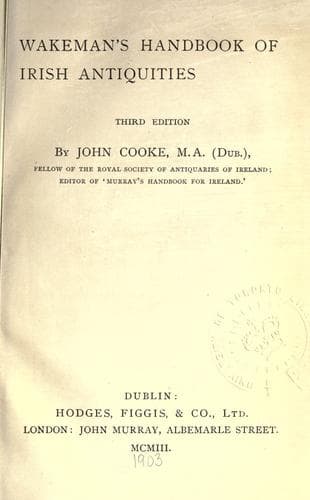
Wakeman's handbook of Irish antiquitiesWakeman, W. F. (William Frederick)
History
Wakeman's handbook of Irish antiquities
Wakeman, W. F. (William Frederick)
Ireland -- Antiquities
The _Island of Inismurray_, lying about 4½ miles off the coast of
Sligo, contains within its narrow limits an extraordinary collection
of antiquarian remains. These are enclosed in an area measuring 175 by
135 feet, formed by a cashel of rude stones, which varied in height
from 7½ to 13 feet, and from 7 to 15 feet in thickness. In 1880 the
Board of Public Works undertook the restoration of these remains. The
features of the cashel were much interfered with; it was made of nearly
uniform height, parts being pulled down to build up others which had
fallen; the traces of the interior steps were converted into niches to
hold cross-inscribed stones, and the southern entrance was entirely
rebuilt. There were four entrances to the cashel, with probably a fifth
on the south-west face. Two of these in the north-west side are of
special interest. The approach from without is through a low doorway
about 2½ feet high and 2 feet wide at lintel, but slightly more at
bottom. Passing through 3 feet of a passage, a dome-shaped chamber is
entered 6 feet in diameter and 7 feet high. Across the middle the floor
rises with a perpendicular face of earth 2½ feet high, the original
elevation being probably greater. From the chamber the passage inwards
is the same as the outer. These are similar in plan to the passages
and chambers of many souterrains, and were probably constructed for
defensive purposes. The interior of the wall showed that it was stepped
similar to Staigue Fort. The area of the court was divided into four
unequal sections by stone barriers. There are several chambers in the
walls; but for what purpose they were originally intended it is now
difficult to determine. In the area are three clochauns. One is 13
feet in diameter, and from floor to top of vaulted roof 14 feet. There
is a projecting ledge on one side, intended for rest or sleeping. The
doorway is massive, and measures 3 feet 8 inches high, with sides
inclining from 2 feet 2 inches to 1 foot 9 inches. The shape is oval,
and the walls commence to slope a short distance from the ground,
and approximate by overlapping in the usual way. It is known as the
‘School House’; and as it evidently belongs to the primitive class of
structure, it forms an interesting link of pagan days with the first
missionary residents on the island. Here, as on the Island of Aran and
elsewhere, as Petrie points out, the early Christians utilised the
pagan forts in founding their religious establishments. The walls they
raised around others differ materially from the primitive cashel in
strength, height, and the characteristic features we have described.[88]
* * * * *
Public-domain text, read in full here on John Shaqi.
Reviews
Reviews
No reviews yet
Be the first to share your thoughts on this work.
Elsewhere in the archive
Join the Discussion
Join the discussion
Sign in to leave a comment or review.
Sign InorCreate an account