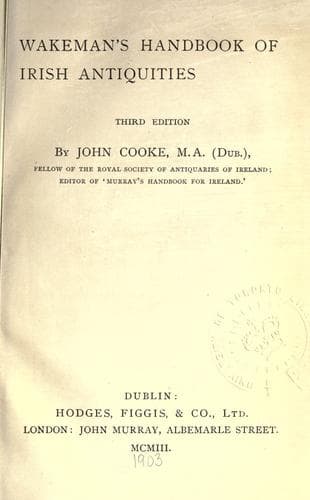
Wakeman's handbook of Irish antiquitiesWakeman, W. F. (William Frederick)
History
Wakeman's handbook of Irish antiquities
Wakeman, W. F. (William Frederick)
Ireland -- Antiquities
The _Grianan of Aileach_, the ancient seat of the O’Neills, kings of
Ulster, is a fort on the summit of a hill 803 feet high, about 5½ miles
from Derry, overlooking the east shore of Lough Swilly. It consists of
three extensive circular ramparts, greatly dilapidated, formed of earth
mixed with stones, the outer enclosing an area of 5½ acres. Within the
inner breastwork is a cashel, a circular wall about 17½ feet high,
enclosing an area of 77 feet in diameter. It has an average thickness
at the base of 13 feet, and is not quite perpendicular, but has a
curved terrace-shaped slope, like Staigue Fort in Kerry. On each side
of the entrance gateway are passages within the thickness of the wall,
extending in length to one-half of its entire circuit. These do not
communicate with the gateway, but have entrances from the area at their
northern and southern extremities. The passages are 5 feet high, and
over 2 feet wide, with sloping sides, the roof being formed of stones
laid horizontally. The entrance gateway is 4 feet 3 inches wide at the
base; the sides are inclined, and the original height was probably
6 feet. On each side is a reveal intended to receive the doors which
barred the passage. This great residence was destroyed by Murkertagh
O’Brien, king of Munster, in 1101. The Cashel was restored by Dr.
Bernard, of Derry, during the years 1874–8.
Out of the mass of myths and legends concerning primitive times in
Ireland, it is invariably difficult, if not impossible, to disentangle
the slight threads of fact from the web of romantic fables of bards
and chroniclers. These have their value, however, when supported or
tested by the evidence gleaned in the actual field of archæological
investigation. Isolated geographically as Ireland was, she was yet the
shore upon which the successive waves of influence sweeping over Europe
spent themselves. She was, as a rule, not only late in being brought
under the sphere of new influences, but some had especial opportunity
of development, and many retained their hold and flourished long after
they had ceased to exist elsewhere. The extent of the forts of Ireland,
and the length of time they remained in occupation, is an example of
this.[89]
Public-domain text, read in full here on John Shaqi.
Reviews
Reviews
No reviews yet
Be the first to share your thoughts on this work.
Elsewhere in the archive
Join the Discussion
Join the discussion
Sign in to leave a comment or review.
Sign InorCreate an account