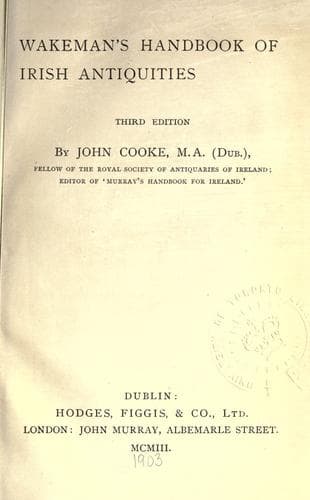
Wakeman's handbook of Irish antiquitiesWakeman, W. F. (William Frederick)
History
Wakeman's handbook of Irish antiquities
Wakeman, W. F. (William Frederick)
Ireland -- Antiquities
Primitive man everywhere seems to have used stone, wood, and bone in
the manufacture of weapons before he advanced to a knowledge of the
use of metal. The terms ‘Stone,’ ‘Bronze,’ and ‘Iron,’ adopted first
by Scandinavian archæologists, are now generally used to signify
the successive ‘Ages’ of human development from prehistoric into
historic times. The vast quantity of stone and bronze objects found
in Ireland are conclusive that at certain remote periods they were in
general use. It is therefore reasonable to suppose that stone only
was at one time used, and that bronze, on account of its superiority,
in time superseded the older material. Though each prevailed, and
was characteristic of its own period, yet no hard-and-fast line
can be drawn between them, and the overlapping occurs everywhere.
We have evidence in lake-dwelling remains to show that, after
iron was introduced, stone, bronze, and iron implements were used
simultaneously. Stone weapons were in use down to the Middle Ages, and
stone hammers were used in remote places down to modern times.
The antiquity of man in Ireland has long been a subject of general
archæological interest and discussion. He is considered by some
authorities to have been contemporary with the _cervus giganteus_,
whose remains have been discovered in such large numbers in the
country. These have been found in the crannogs of Cloonfinlough,
Loughrea, and in the caves of Ballynamintra. Professor Leith Adams and
Messrs. Kinahan and Ussher, in the exploration of the latter, found the
bones in connexion with ‘battered and chipped’ hammer-stones, which
they had little doubt was the work of man to extract the marrow.[90]
They were found mixed with the remains of Neolithic fauna, red-deer,
horse, ox, grizzly bear, wolf, badger, fox, dog, etc.
The evidence of the existence of Palæolithic man lies deep in the
drifts or raised banks of ancient rivers, or far below the present
floors of caves. If he ever existed in Ireland, he has left no
conclusive evidence of his presence, so far as our knowledge goes.
The relics of Neolithic man lie near the surface, and evidence of his
existence has been found throughout the length and breadth of the land.
When he started in Ireland, he is supposed to have had a considerable
knowledge in the use of stone weapons and skill in their manufacture.
In fashioning flint implements, in the selection of the hardest and
best kinds of stone, in shaping and polishing these for various uses,
he showed an intelligence and skill of no mean order. Finished flint
articles have been found in the north of Ireland in thousands; and the
refuse of their manufacture exists in large quantities. Few countries
equal Ireland in the number of stone implements which have been
discovered of every kind, or can show greater excellence in their style
and finish.
* * * * *
Public-domain text, read in full here on John Shaqi.
Reviews
Reviews
No reviews yet
Be the first to share your thoughts on this work.
Elsewhere in the archive
Join the Discussion
Join the discussion
Sign in to leave a comment or review.
Sign InorCreate an account