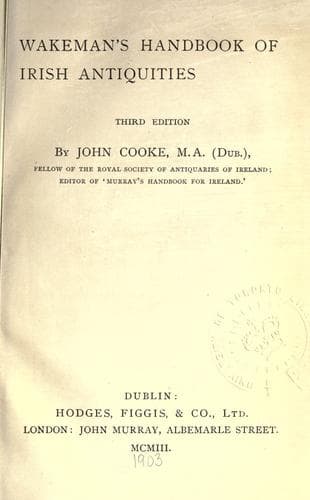
Wakeman's handbook of Irish antiquitiesWakeman, W. F. (William Frederick)
History
Wakeman's handbook of Irish antiquities
Wakeman, W. F. (William Frederick)
Ireland -- Antiquities
Most writers in the past have attributed the stone forts of the west
of Ireland to the Firbolgs of the first century of our era, basing
their conclusions on a bardic legend recited a thousand years after
their invasion. But the forts are too numerous, and many of too vast
proportions, for the stricken remnants of a race to have raised
in their defence when driven to their last extremity on the wild
shores of the Atlantic. The far-fetched theory, too, like many other
such, that they were erected by sea-rovers to hold their spoils, is
equally untenable for the same and other very apparent reasons. The
absence of water-supplies within the forts, which has puzzled some, is
paralleled in the British and other European forts, and was no doubt a
precautionary measure to prevent the pollution of springs and wells.
It is an indication, also, that the forts were not intended to stand
a prolonged siege, a practice in warfare of a later time, but were
raised as a protection against raiding and sudden assault. Their height
above the sea was to give greater security, and their commanding sites,
with due precaution in watching, prevented the dwellers being taken
unawares. When life and property were unsafe, the desire for security,
as well as social habit, gave rise to these works. The dwellers
fortified their camps for themselves and their cattle, moving about
freely in times of peace, and withdrawing to these strongholds in times
of danger. They were as much a necessity in early days as the walls and
bastions defending the towns in the Middle Ages. Their extraordinary
number, out of all proportion compared to Scotland with its 1300,
testify to the fact that the land was not a peaceful land long before
the coming of the Dane. It is difficult in the present state of our
knowledge even to approximate the date of their first introduction,
as it is difficult, if not impossible, to assign a definite date to
any archæological period in Ireland. The Irish forts are among the
finest of a type of primitive defences extending across the continent
of Europe from the Atlantic to the Black Sea and the Mediterranean
shores of Greece. The construction of the walls in sections, and the
passages and chambers, link the western forts through similar, though
more perfect, features with the cyclopean walls of Tiryns, Mycenæ, and
the Punic cities of North Africa. The cashels, the mounds, and the hill
forts with their encircling ramparts have their counterpart in the
middle latitudes of Europe, in the lands once dominated by the Celt,
and which cover a period from the Bronze Age, at least, to the days
of the Roman occupation. In Ireland their use ranges from prehistoric
times down to the Middle Ages; and some were occupied for ordinary
dwelling purposes down to modern times.
CHAPTER VII.
THE STONE AGE.
FLINT ARROW-HEADS--STONE CELTS--AXE-HAMMERS.
Public-domain text, read in full here on John Shaqi.
Reviews
Reviews
No reviews yet
Be the first to share your thoughts on this work.
Elsewhere in the archive
Join the Discussion
Join the discussion
Sign in to leave a comment or review.
Sign InorCreate an account