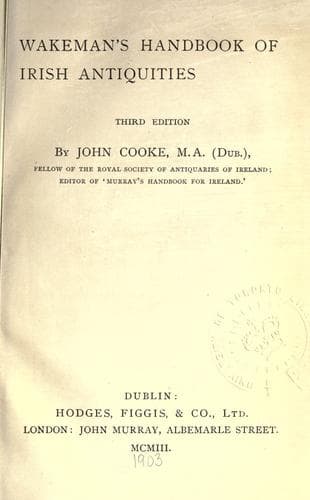
Wakeman's handbook of Irish antiquitiesWakeman, W. F. (William Frederick)
History
Wakeman's handbook of Irish antiquities
Wakeman, W. F. (William Frederick)
Ireland -- Antiquities
_Axe-hammers._--The perforated axe-hammers show an advance in the
manufacture of stone implements. Of these there are several varieties;
some, and probably the earliest, are of the celt type; others are blunt
at both ends forming true hammers; but the latter type come near to
the modern axe-head in shape. They are well-designed, highly polished,
and formed of stone selected for its hardness. The spot for the hole
seems to have been first chipped; and the perforation was then made by
rotatory friction with a suitable stone, piece of bone or wood, and the
use of sand and water. The operation was usually done on both sides,
as a section of the stone shows that the hole diminishes towards the
middle. Many specimens show a cylindrical perforation, the drilling
of which could be done with a piece of hollow wood, bone, or metal.
Cores cut out in this way have been found in numbers in the Swiss
lake-dwellings; but, as far as we are aware, no core of this kind has
been found in Ireland. One head with an incomplete perforation may be
seen in the Academy collection; this shows the cores, but broken on
both sides. Many of the true round hammer-shaped heads are cleanly
drilled, and with a metal tool. They are evidently late in date, and
were probably used in the working of the finer metals, gold and
silver. Two of the many fine examples in the Academy collection of the
axe type are here figured. The larger is composed of serpentine; it is
8¼ inches long, and weighs about 6½ pounds. It has a broad hatchet-edge
with a heavy head behind the handle. The other, found in the Shannon
at Athlone, is of hornblendic syenite; it is 5½ inches in length, with
grooves round the perforated sides. These are highly polished, and are
among the finest specimens yet discovered in the British Isles.
[Illustration: Perforated Stone Axe-hammers.]
CHAPTER VIII.
THE BRONZE AGE.
COPPER CELTS--BRONZE--ITS ANTIQUITY AND SOURCE--BRONZE CELTS--THE
FLAT CELT--THE FLANGED OR WINGED CELT--THE SOCKETED CELT--
CELT MOULDS--SWORDS--RAPIERS--BROAD SCYTHE-SHAPED SWORDS--
SWORD SHEATHS--THE LISNACROGHERA ‘FINDS’--SPEAR-AND
JAVELIN-HEADS--ORNAMENTED SPEARS--CRANNOG SPEARS--SHIELDS--BRIDLE
BITS--CALDRONS--TRUMPETS--ORNAMENTS, BRONZE AND GOLD--
TORQUES--LUNULÆ--TIARAS--FIBULÆ--THE BROIGHTER GOLD ‘FIND.’
The Early Irish traditions--so insisted on by many writers--of the
successive invasions of Ireland by various races may contain a kernel
at least of the truth of successive waves of the men of the Stone Age,
overcome in time by a race stronger and better equipped with metal
weapons.
Public-domain text, read in full here on John Shaqi.
Reviews
Reviews
No reviews yet
Be the first to share your thoughts on this work.
Elsewhere in the archive
Join the Discussion
Join the discussion
Sign in to leave a comment or review.
Sign InorCreate an account