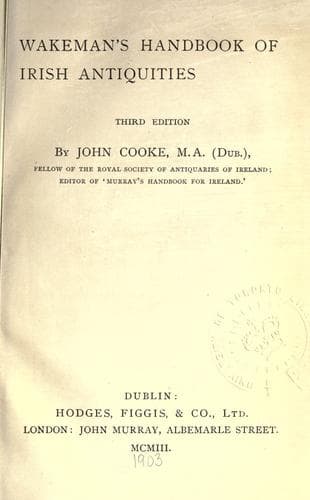
Wakeman's handbook of Irish antiquitiesWakeman, W. F. (William Frederick)
History
Wakeman's handbook of Irish antiquities
Wakeman, W. F. (William Frederick)
Ireland -- Antiquities
The discovery of metal for the manufacture of implements marked a new
epoch in the history of man. Copper was evidently known long before
the discovery was made of using it with an alloy; but, owing to its
softness, it could not supersede the use of stone. The question of
whether there was, generally speaking, a Copper Age is still a matter
of archæological controversy. The number of copper implements found is
small, compared to the vast quantities of bronze of great variety that
have been discovered. Flat copper celts have been found in Cyprus, the
chief source of supply of the mineral to the Aegæan, in Hissarlik,
in Hungary, Denmark, Sweden, France, Italy, and in Central India; but
these latter are thought to be of late date, having been associated
with objects of silver.
The National Museum, Dublin, contains 84 copper celts, the collection
having much increased since the compilation of Wilde’s _Catalogue_,
when the number stood at 30. The number found in Ireland up to the
present time is about 150; and specimens have been discovered in about
half the counties and in all the provinces. The copper celts are of a
primitive type, and were evidently modelled after those of stone. The
smallness of the number may be due either to the probability of their
being recast in the manufacture of tools and weapons on the discovery
of bronze; or, that the metal proving soft, it was not largely used,
being inferior in consistency to stone. Bronze celts have been found
of a primitive character similar to the copper, so that they may have
belonged to the same period of time. From this and other considerations
it has been urged that a Copper Age did not exist in Western Europe,
though such, no doubt, prevailed in the countries bordering on the
Mediterranean, especially in Egypt. The latter country was in the
Neolithic Age under the ‘New Race’; and copper came into use at the end
of this Pre-dynastic Period.
In all copper celts hitherto analysed in Ireland, a very small quantity
of tin has been found, varying from about one per cent. to a mere
trace. Whether the presence of tin in the copper is intentional or
accidental is not definitely known; but it seems likely to have
existed in the ore with other impurities.[92] Copper seems to have
been in general use in Ireland; for, among other objects of this
metal, awls, a halbert, and blades of knives have been discovered. The
existence of native ore renders it likely that it was worked as soon as
its properties were known; and this is supported by the fact that the
word _umha_, the Irish name for copper, is pure Celtic. Tin exists in
small quantities in Ireland, especially in the sand and gravel deposits
of the Wicklow streams; but as to the method and means of mining,
and how far it was carried on in those early days, we know nothing
definite. Copper workings have been discovered, of a primitive type, in
Cork and Kerry, containing stone implements among the refuse.
Public-domain text, read in full here on John Shaqi.
Reviews
Reviews
No reviews yet
Be the first to share your thoughts on this work.
Elsewhere in the archive
Join the Discussion
Join the discussion
Sign in to leave a comment or review.
Sign InorCreate an account