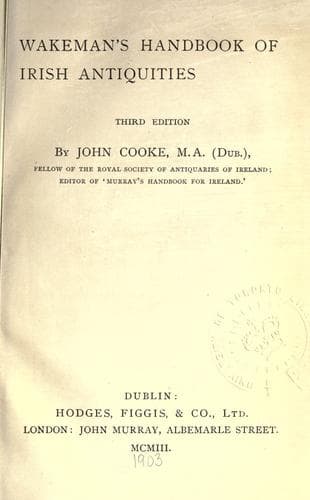
Wakeman's handbook of Irish antiquitiesWakeman, W. F. (William Frederick)
History
Wakeman's handbook of Irish antiquities
Wakeman, W. F. (William Frederick)
Ireland -- Antiquities
The implements were mounted by inserting the handle between the
flanges, and secured by a ligature of some kind tightly coiled round
the butt. To secure the head from flying off the handle a loop was,
in time, added to the inside edge of the celt by which it was firmly
braced to the haft. The loop is almost invariably single; double-looped
celts (see fig. 7) are very rare, and but a few specimens have been
found in Ireland. The discovery of a mounted celt is also very rare,
as the wooden handles, to which they seem generally to have been
attached, decayed in the lapse of time. A very interesting example is
shown in fig. 8. This celt was found in the bed of the River Boyne near
Edenderry. The handle is about 14 inches long, and the head possessed
a loop which was worn through--probably, as Wilde thinks, by a metal
brace which secured it.
[Illustration: Fig. 7. Double-looped Flanged Celt with Stop-ridge.]
[Illustration: Fig. 8. Looped Celt with Original Handle.]
* * * * *
_The Socketed Celt._--In tracing the development of these celts, with
specimens, it will be noted that the flanges grow bolder and more
projecting, and in time curve inwards, and that the stop becomes
more prominent. By merging it, as we have said, into the wings, and
gradually removing the decreasing shank, the socket was formed. There
was a marked advance here in casting, as provision had to be made for
a core to form the socket. ‘The lip of the socket,’ says Wilde, ‘is
generally ornamented, and very frequently by one or more raised bands
or fillets; sometimes by a very well-cast roped ornament, evidently
made to represent a cord of twisted gut. A special description of cast
ornament, consisting of longitudinal raised bars, generally ending in
annular or button-like projections, sometimes occupies the side of this
implement; ... but in no case is the ornamentation produced either by
the hammer, punch, or graver, as in the flat simple celt.’[97] There
are several varieties of the socketed celt, as the illustrations show.
Figures 9 and 10 are 4 inches and 4¼ inches in length respectively,
and are characteristic of the plain class of Irish socketed celt,
though differing materially from each other in particulars of shape,
breadth, position of the loop, and ornament. Of the same variety are
figures 11 and 12, drawn one-fourth the actual size. Fig. 13 represents
a small and well-decorated celt, and is drawn one-half the size of
the object. Fig. 14 represents a flat celt 4½ inches long, with oval
socket internally, and a small raised linear ornament. Fig. 15 shows
a type of celt rare in Ireland. It is a good example of the axe-shaped
implement; it is 3¾ inches long, and about the same across the cutting
edge. Fig. 16 is a fine specimen of the long narrow quadrangular celt:
it is 5⅜ inches in length and 1⅜ inches in breadth. It is very rare in
Ireland, and but a few specimens have been found in the country. Some
Public-domain text, read in full here on John Shaqi.
Reviews
Reviews
No reviews yet
Be the first to share your thoughts on this work.
Elsewhere in the archive
Join the Discussion
Join the discussion
Sign in to leave a comment or review.
Sign InorCreate an account