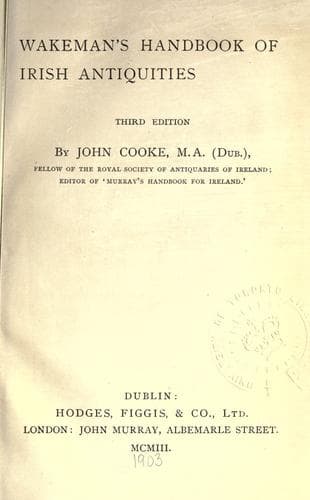
Wakeman's handbook of Irish antiquitiesWakeman, W. F. (William Frederick)
History
Wakeman's handbook of Irish antiquities
Wakeman, W. F. (William Frederick)
Ireland -- Antiquities
sawing, and lathe-work were done by the pyramid-builders on the hardest
stone with fine cutting points. He considers modern drill-cores far
inferior to those discovered in Egypt. ‘By the side of the ancient
work,’ he says, ‘they look wretchedly scraped and irregular; ... the
fine work shows the marks of just such tools as we have only now
re-invented.’[96]
* * * * *
_Bronze Celts._--The most common weapons or implements of bronze found
in Ireland are _celts_, which have been generally classified as flat,
flanged, winged, and socketed. The ordinary bronze celt is rarely more
than seven inches in length, and some have been found which scarcely
measure an inch and a half.
* * * * *
[Illustration: Fig. 1. Flat Bronze Celt--scale one-half.]
[Illustration: Fig. 2. Celt with lunette-shaped edge and re-curved
points.]
_The Flat Celt._--The earliest type is flat and wedge-shaped, and, like
the stone weapon, appears to have been fixed by the smaller end into a
wooden handle. The accompanying figure (1) shows a long, narrow celt
of gold-coloured bronze, ornamented on side and edges; fig. 2 is an
ornamented celt with lunette-shaped edge and re-curved points.
* * * * *
_The Flanged or Winged Celt_ was a simple development of the latter,
resulting from the necessity of affording a better hold to the weapon
when fastened to a cleft handle. The flanges were produced either
by hammering the edges or by original casting. It will be noted, in
figures 3 and 4, that a stop-ridge runs across the handle portion of
the weapon, to prevent the celt being pressed into the haft when used
with force. The position and shape of the ridge vary in the gradual
development of the implement, until, merged in the flanges, we have
a socket. The flanges vary much in size, and the term ‘winged’ is
sometimes confined to celts with wide or more projecting flanges.
[Illustration: Figs. 3 and 4. Flat and Flanged Celts with Stop-ridge.]
Fig. 5 has lozenge-shaped flanges or wings 1¾ inches wide; ‘the stops
are but slightly developed, and must have been bedded into the sides of
the handle, which appears to have passed below them’; this will be seen
by the groove projecting into the cutting half of the implement. The
external knob was probably intended for holding the tying in its place.
Fig. 6 is a broad-winged and stop-ridged celt with sides and faces
ornamented. To the flanged type of celt the name ‘Palstave,’ a word of
Scandinavian origin, is generally applied.
[Illustration: Figs. 5 and 6. Winged or Flanged Celts.]
Public-domain text, read in full here on John Shaqi.
Reviews
Reviews
No reviews yet
Be the first to share your thoughts on this work.
Elsewhere in the archive
Join the Discussion
Join the discussion
Sign in to leave a comment or review.
Sign InorCreate an account