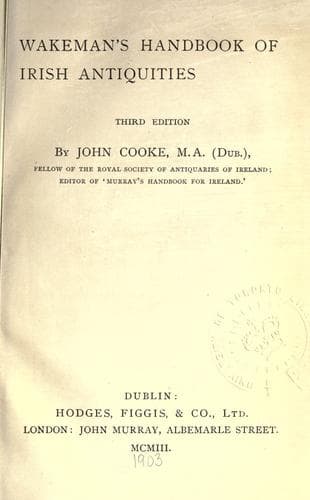
Wakeman's handbook of Irish antiquitiesWakeman, W. F. (William Frederick)
History
Wakeman's handbook of Irish antiquities
Wakeman, W. F. (William Frederick)
Ireland -- Antiquities
Blade No. 2, though somewhat smaller, is in style very like that just
noticed. It is finely cast, and has, like the first, a bevel-edge. Its
tang exhibits five plain bronze rivets, and three apertures for the
reception of others which no longer remain; its length is 28½ inches.
No. 3 is 26 inches long, and retains ten handle-rivets, and provision
for the reception of two more which have been lost. It has a narrow
grooved feather-edge, but no midrib.
No. 4 is a very beautiful leaf-shaped sword richly moulded, and
presenting a broad and finely graduated central rib, by which great
strength is added to the blade, rendering it equally fit for thrusting
or striking. The tang appears to have originally possessed ten rivets,
of which only two remain; the length is 23½ inches.
No. 5. This blade is remarkable for the shortness of its tang, which
is pierced for four rivets only. It is not bevelled at the edges, but
shows a sharp central ridge of unusual thickness.
No. 6 is 18½ inches long; it ‘has a thick flat midrib and grooved side
bevels, or feather-edges, with hilt notches in the base of the blade.
The handle-plate, which is slightly defective, has four rivet-holes,
and has been welded by an over-lap.’ (Wilde.)
The precise manner in which the swords were hafted remained until
lately a matter of conjecture. It has been shown, however, by existing
examples, that the mounting probably generally consisted of bone;
wood also may have been largely used. While in the northern and other
parts of the Continent of Europe, bronze swords are commonly found with
handles of the same metal, we cannot point to a single Irish specimen
so furnished. Rapiers and dagger-knives of bronze, the blades and
handles of which are of the same material, have frequently been found
in Ireland. The handle-plates of swords are often found broken; and in
some cases the break has been welded, which shows that this was the
weakest part of the weapon. Bronze swords everywhere seem to have been
used more for thrusting in close combat than for striking; and although
the weapon ultimately developed into possessing a massive bronze
handle, it was not until iron came into general use that the warrior
was armed with a weapon strong enough at the hilt to deliver a downward
stroke without snapping the blade.
[Illustration: Dagger hafted with Bronze.]
* * * * *
Public-domain text, read in full here on John Shaqi.
Reviews
Reviews
No reviews yet
Be the first to share your thoughts on this work.
Elsewhere in the archive
Join the Discussion
Join the discussion
Sign in to leave a comment or review.
Sign InorCreate an account