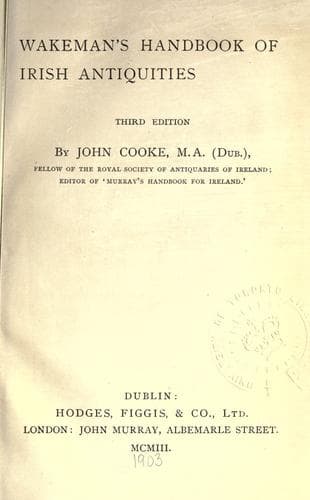
Wakeman's handbook of Irish antiquitiesWakeman, W. F. (William Frederick)
History
Wakeman's handbook of Irish antiquities
Wakeman, W. F. (William Frederick)
Ireland -- Antiquities
The _Rapier_ partakes very much of the character of the leaf-shaped
sword, having the broad triangular and the long narrow types, and
are probably from the same school of manufacture. Except in the
circumstance of being usually very long and narrow in the blade, they,
as a rule, differ little from the swords and daggers with which they
are sometimes found. Instead of a handle-plate, the butt of the blade
of the rapier widens out for the reception of the haft, to which it
was fastened by two or more rivets. In some cases the blade was only
notched instead of pierced for the rivets; while in others it was both
perforated and notched. Like the daggers, the handles were occasionally
of bronze; but there is reason to believe that their mounting was more
usually of bone. Moulds of stone used for the purpose of casting this
class of weapon are rare; but a couple of specimens may be seen in the
National Museum.
* * * * *
_Broad Scythe-shaped Swords._--These are usually thick, heavy,
round-pointed weapons, from about 8 to 16 inches in length and several
inches broad at the butt, where they were attached to the haft by two
or more heavy rivets, the heads of which are sometimes an inch across.
About one-half of those in the National Museum are of the peculiar
curved or scythe-shaped kind, and the greater proportion have thick
central midribs. These, according to Wilde, seem to have been fastened
at right angles to the hafts ‘like modern halberds.’ This view is
generally accepted; but their great antiquity among metal weapons is
probably not so great as Wilde seemed to think.
Public-domain text, read in full here on John Shaqi.
Reviews
Reviews
No reviews yet
Be the first to share your thoughts on this work.
Elsewhere in the archive
Join the Discussion
Join the discussion
Sign in to leave a comment or review.
Sign InorCreate an account