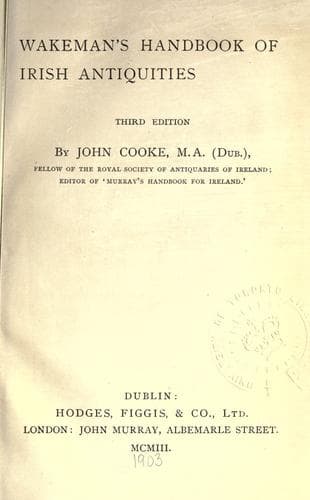
Wakeman's handbook of Irish antiquitiesWakeman, W. F. (William Frederick)
History
Wakeman's handbook of Irish antiquities
Wakeman, W. F. (William Frederick)
Ireland -- Antiquities
[Illustration: Bronze Dish from Cloonfinlough Crannog, Co. Roscommon.]
* * * * *
_Bronze Trumpets._--A large number of war-trumpets have been found in
Ireland during the past two centuries; and an interesting series of
these in the Academy collection is to be seen in the National Museum.
These instruments are usually classified into (1) those blown in
the ordinary way from the end; and (2) those having the end closed,
and sounded from an opening some distance from it in the body of
the instrument. Among the examples found, some are cast, and others
riveted; many are ornamented, and some have highly decorated discs
of the Late Celtic period round the mouth. When not in use they were
probably slung from the shoulder, some of the instruments exhibiting
loops to which straps could be attached.
[Illustration: Bronze Trumpets, Academy Collection, National Museum.]
An interesting group of trumpets from the Academy collection is here
represented. The trumpet to the left of the lower central figure is
of cast bronze and is 24 inches in length along the convex side. ‘It
requires,’ says Wilde, ‘a great exertion to produce even a dull sound
with this instrument.’ The central figure, and that immediately above
it to the right, are also cast, and have holes on the inner sides.
It has been thought that this type of instrument was used more for
speaking than blowing; and Latin writers notice the clamour and noise
of trumpets made by the Celts on the battle-field. The fourth trumpet
is of two portions, and the combined length is about 6 feet. It is
not cast, but made of thin sheet bronze; the edges are not soldered,
but are held together by thin stripes of metal running along the seam
internally and externally, and riveted to each side by alternate studs
of bronze. The disc at the end is about 3 inches wide, and has a fine
design of Late Celtic pattern punched on the metal. The fifth figure
in the illustration represents an exceptionally fine trumpet, and one
of the most remarkable yet discovered in Europe for its size. It is 8
feet 5 inches in length, and is in two portions, formed, like the last,
of sheet bronze, the edges being held together by an internal strip
of metal riveted to the side. This, as Wilde well says, is the most
perfect thing of its kind yet discovered; and if the instrument was
originally of one piece, exceptional skill and ingenuity were shown in
the riveting.[104]
* * * * *
Public-domain text, read in full here on John Shaqi.
Reviews
Reviews
No reviews yet
Be the first to share your thoughts on this work.
Elsewhere in the archive
Join the Discussion
Join the discussion
Sign in to leave a comment or review.
Sign InorCreate an account