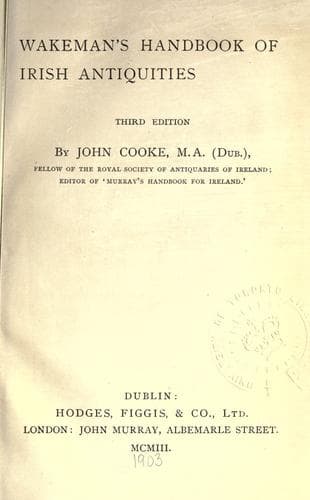
Wakeman's handbook of Irish antiquitiesWakeman, W. F. (William Frederick)
History
Wakeman's handbook of Irish antiquities
Wakeman, W. F. (William Frederick)
Ireland -- Antiquities
_Bronze Ornaments._--Pins of wood or bone seem to have been the
material used in the earliest articles for fastening the dress. Bone
pins have been found in considerable numbers in early burial sites, and
in crannog remains; many are ornamented and they were very probably
used long after the introduction of bronze. On the discovery of this
metal the beauty of the colour naturally led to its immediate adoption
for objects of personal use and decoration. The number of these objects
that have been found in Ireland is very great, and they consist of
pins, fibulæ, brooches, rings, bracelets, &c. The bronze pin, which was
derived from the ring-brooch, shows a regular development; first in
the solid head, which is very varied; later the head was pierced for a
ring, or a ring was riveted to it. The ring in time became the special
object of development, similar to the process of the parent ring-brooch
which ended in the production of those splendid examples of metal
work--the Celtic brooches.
[Illustration:
Fig. 1. Fig. 2.
Disc and Penannular Types of Ring Pins.]
The accompanying figures illustrate varieties of ring-pins not uncommon
in Irish collections. Fig. 1 has a ring of the disc type with a plaited
design, which plays freely in the loop of the pin-head. Fig. 2 has
the penannular type of ring with coin-shaped ends. Spring brooches or
fibulæ of the kind shown in fig. 3 are rarely found in Ireland. This is
a beautiful example of the ‘serpent’ type, and ‘is curiously frosted
with a raised irregular pattern all over the surface; but whether
produced in casting, or caused by sudden cooling of the metal, is
uncertain.’ Fig. 4 represents a beautiful example of the hinge-brooch
and one of the finest ever discovered. It was found in Ardakillin
Crannog, near Strokestown. The ends show Late Celtic design; and the
ornament was produced by punching from the back. The curved body of the
brooch has a raised plaited design of the usual type; and this piece
appears to have been cast.
[Illustration: Fig. 3. Bronze Fibula.]
[Illustration: Fig. 4. Bronze Hinge-Brooch, drawn full size.]
Penannular rings, more common in gold than in bronze, have frequently
been found, the larger size having been used as bracelets or armlets.
Two of the latter are figured on next page. One is a massive ornament
consisting of a double rope-like band joined to a small ring. The
second consists of ‘a double circlet of thin bronze, with free ends,
one of which is perforated for looping on a stud placed behind the
central enlargement; the other extremity, as well as the central space,
is decorated with an embossed bird-head pattern.’ (Wilde.)
[Illustration: Figs. 5 and 6. Bronze Armlets, one-half real size.]
* * * * *
Public-domain text, read in full here on John Shaqi.
Reviews
Reviews
No reviews yet
Be the first to share your thoughts on this work.
Elsewhere in the archive
Join the Discussion
Join the discussion
Sign in to leave a comment or review.
Sign InorCreate an account