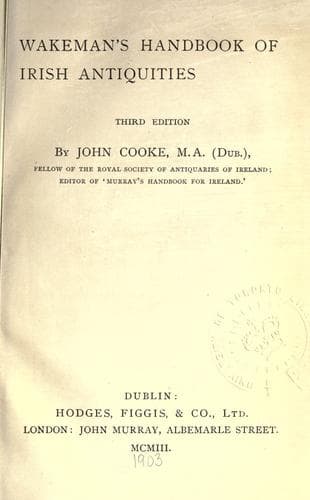
Wakeman's handbook of Irish antiquitiesWakeman, W. F. (William Frederick)
History
Wakeman's handbook of Irish antiquities
Wakeman, W. F. (William Frederick)
Ireland -- Antiquities
_Torques._--The term ‘Torque’ is applied to the various kinds of
collars generally worn round the neck, by the Celtic tribes of the
Continent and the British Isles. Those of the largest kind were worn
round the waist, or across the breast, and the smallest on the arm or
wrist. The torque, familiar to all readers of Roman history, and worn
round the neck, was a twisted rope-like ornament with bulbous ends at
the front. Frequent mention is made of the torque in Irish records, and
their use ranged over a long period of time. Considerable numbers, and
of great variety, have been discovered in Ireland; and some are among
the largest yet found in Europe. ‘The simplest form,’ say Wilde, ‘is
that of a square bar of gold, twisted so as to present a funicular, or
rope-like figure. In the more complete forms, two or more flat stripes
of metal, joined at their inner edges, are twisted spirally.’
[Illustration: Gold Torques, Royal Irish Academy Collection.]
The subject of the above illustration is a group of four torques of
types usually found. The two outer examples were dug out of a bank
of earth on the Hill of Tara. This was in 1810--a time when little
was known about Irish antiquities; and the torques were hawked about
the streets of Navan for sale as old brass, but nobody would purchase
them. They were found in the immediate vicinity of the monuments
identified by Petrie as Mael Bloc and Bluicni, two magical stones of
the pillar class. Wilde states that these ornaments were purchased by
the Duke of Sussex, from whom they passed to the firm of West; and in
1839 they were purchased by subscription, and presented to the Royal
Irish Academy. The outer figure represents as far as we are aware,
the largest ever recorded to have been found anywhere. It is 5 feet 7
inches long, weighs 27 ounces and 7 pennyweights, and is formed of four
flat bars, united at their edges when straight, and then twisted.
The next in size measures 5 feet 6 inches in length, and is twisted
closer; its weight is 12 ounces, 7 pennyweights, and 13 grains. These
large torques were seemingly intended to be worn over the shoulder and
across the breast; the smaller examples were evidently for the neck.
* * * * *
Public-domain text, read in full here on John Shaqi.
Reviews
Reviews
No reviews yet
Be the first to share your thoughts on this work.
Elsewhere in the archive
Join the Discussion
Join the discussion
Sign in to leave a comment or review.
Sign InorCreate an account