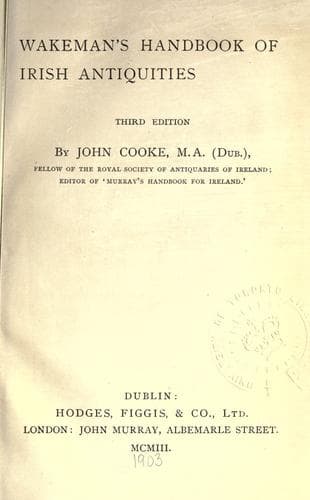
Wakeman's handbook of Irish antiquitiesWakeman, W. F. (William Frederick)
History
Wakeman's handbook of Irish antiquities
Wakeman, W. F. (William Frederick)
Ireland -- Antiquities
The recorded instances of the discovery of gold ornaments and other
objects in Ireland are very numerous, and date back for several
centuries.[106] The collection of the Royal Irish Academy is one of
exceptional interest and value, and numbers over 350 specimens. These
have been classified by Wilde as follows: ‘Diadems, tiaras, lunulæ,
hair-plates, and ear-rings; those used for the neck--as, for example,
gorgets, small torques, flattened beads, globular balls, and necklaces;
for the breast--as circular plates, fibulæ, and brooches; for the
limbs--as armillæ, bracelets, and finger-rings; and for the chest and
waist, in the form of large torques: besides several minor trinkets
and miscellaneous articles, such as bullæ, small circular boxes,
penannular-shaped articles--supposed to represent money--bracteate
medals, and some other objects of undetermined use.’[107]
Notwithstanding the great number of gold objects found in Ireland, and
preserved in public museums or private collections, the majority of
those discovered found their way to the melting-pot; some jewellers,
according to Wilde, estimated that they had purchased as much as
£10,000 worth. This is a matter much to be regretted, for the loss
to archæology is great; and it cannot be too widely known that the
Council of the Academy and the Trustees of the National Museum are
prepared to pay, not only the full bullion value of any object found,
but its estimated antiquarian value, which depends on its condition,
rarity, ornamentation, and the very special circumstances under which
it has been discovered. As examples of the losses in question, we may
mention that in 1860 a letter appeared in the _Athenæum_ from Mr.
Clibborn, the then Curator of the Museum of the Royal Irish Academy,
stating ‘that a considerable gold find had been made near Athlone to
the value of £27,000, which had been entirely lost to the antiquarian
world.’ Again, in 1854, during the construction of the Limerick and
Ennis Railway, certain labourers found under a rude cairn an immense
treasure of the precious metal. So great was this find that four days
after the discovery four men departed to America with about £6000 each.
Large numbers of the objects were immediately melted down in Limerick
and neighbouring towns; a few only seem to have been saved from the
crucible.
* * * * *
Public-domain text, read in full here on John Shaqi.
Reviews
Reviews
No reviews yet
Be the first to share your thoughts on this work.
Elsewhere in the archive
Join the Discussion
Join the discussion
Sign in to leave a comment or review.
Sign InorCreate an account