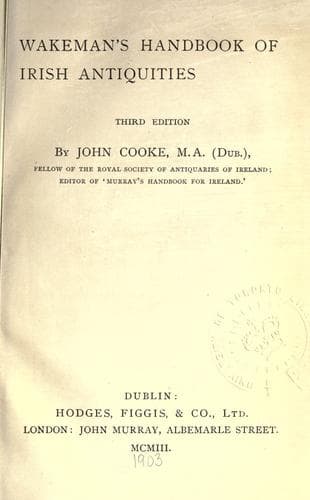
Wakeman's handbook of Irish antiquitiesWakeman, W. F. (William Frederick)
History
Wakeman's handbook of Irish antiquities
Wakeman, W. F. (William Frederick)
Ireland -- Antiquities
Other remains of log-walled huts have been found in Irish
lake-dwellings, particularly in Ulster. The most interesting example
yet known--one indeed that is unique among those hitherto discovered
in the lake-dwellings of Europe--is that described by Captain Mudge in
1853. It lay 16 feet beneath the surface of a bog at Drumkellin, near
Inver, County Donegal; and, not allowing for the lake depth, at least
26 feet of bog must have grown on the site since its erection. Within
the hut was found a stone hatchet, the cutting edge of which is said
to have exactly fitted certain indentations which were observable in
several of its timbers, all of which were of oak. Dr. Keller found
that the piles used in the construction of the dwelling at Ober Meilen
had been cut with stone implements; and experiments made on green
timber with the stone axes found on the site clearly demonstrated the
fact.[109] The Drumkellin hut was perfectly square in plan, 12 feet
each side, and 9 feet high. ‘The framework was composed of upright
posts and horizontal sleepers mortised at the angles, the end of each
upright post being inserted into the lower sleeper of the frame, and
fastened by a large block of wood or fore-lock.[110] The interstices
were filled with a composition of what appeared to be grease and fine
sea-sand. The interior was divided by a flooring into an upper and a
lower chamber, which were probably only used as sleeping-apartments.
Portions were found of the gates of the staked enclosure within which
it stood, resting on a floor of hazel branches covered with fine sand.
There is a model of this hut in the Royal Irish Academy collection.
At Kilnamaddo, County Fermanagh, and other places, remains of log-huts
have been found. The huts at Kilnamaddo were of a very primitive kind,
and lay buried under 17 feet of peat; they were but 4 feet in height
and constructed of oak beams. Some of these showed long clean cuts; and
others, 7 feet in circumference, had mortise-holes pierced through,
which could only have been done with metallic instruments. The remains
at Dunshaughlin--or, more correctly, Lagore--crannog, though probably
of later date than the Drumkellin hut, were very similar to it in
character; they, however, presented no upper chamber.[111]
Public-domain text, read in full here on John Shaqi.
Reviews
Reviews
No reviews yet
Be the first to share your thoughts on this work.
Elsewhere in the archive
Join the Discussion
Join the discussion
Sign in to leave a comment or review.
Sign InorCreate an account