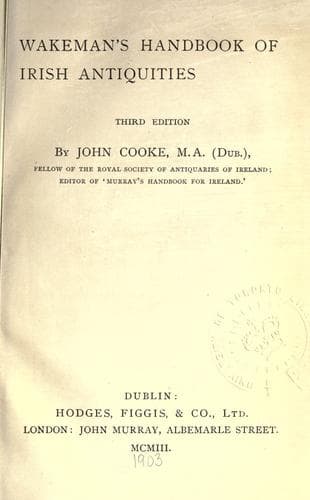
Wakeman's handbook of Irish antiquitiesWakeman, W. F. (William Frederick)
History
Wakeman's handbook of Irish antiquities
Wakeman, W. F. (William Frederick)
Ireland -- Antiquities
Soon after the discovery at Lagore, another lake-dwelling was
discovered in lowering the waters of Roughan Lake, near Dungannon.
Here were found many fragments of pottery and bones, some bronze
spear-heads, and a fine sandstone quern, having an old Irish cross
carved in high relief. To this ‘fortified island’ Sir Phelim O’Neill
retired after the surrender of Charlemont, and held out until boats
arrived, when he was captured in 1653. About the time of these
discoveries, another ‘island’ was laid bare in Lough Gur by similar
draining operations; and a large number of objects of antiquarian
interest, and quantities of bones, were discovered. This is considered
to be one of the earliest lake-dwellings in Ireland; and the district,
as we have already intimated, is exceptionally interesting from an
archæological point of view. There appears to have been no staking or
surrounding timber enclosure in connection with this crannog. Other
discoveries quickly followed; three stockaded lake-dwellings were found
in Monaghan (1843–4). One in Ballinderry Lake, near Moate, yielded
a large quantity of antiquities and bones, and two canoes. In the
drainage of Lough Faughan, County Down, another ‘dug-out’ canoe was
found. During the work of the Commission for the Arterial Drainage and
Inland Navigation of Ireland, twenty-two crannogs were discovered in
the Ballinamore and Ballyconnell districts. The report of the officers
of the Board of Works may be thus briefly stated: The crannogs were
generally circular, and from 60 to 80 feet in diameter; some were
larger, of an oval shape. The stakes were mostly of young oak trees,
from 4 to 9 inches broad, usually sunk in a single row; some, however,
were double, and in a few cases treble. The portions remaining in the
ground usually showed hatched marks. Within the enclosure, the surface
was sometimes covered over with a platform of round logs, from 4 to 6
feet in length, on which was a layer of mixed stones, clay, or gravel.
This construction was in some cases confined to a portion of the
island. ‘Besides these, pieces of oak framing, with mortises and cheeks
cut in them, have been found within the circle of the outer work.’ In
almost every instance a hearth made of flat stones was found near the
centre of the crannog; and in some instances two or three such hearths
existed. One or more querns were usually discovered; and upon the
enclosure or around it were found large quantities of bones, usually
those of cattle, deer, and swine.
Public-domain text, read in full here on John Shaqi.
Reviews
Reviews
No reviews yet
Be the first to share your thoughts on this work.
Elsewhere in the archive
Join the Discussion
Join the discussion
Sign in to leave a comment or review.
Sign InorCreate an account