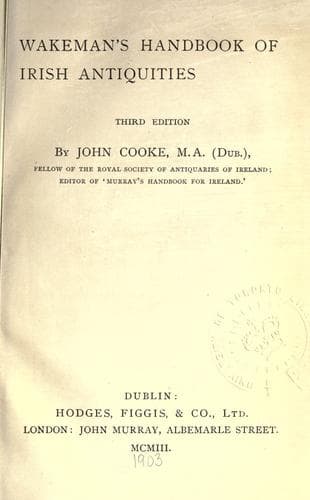
Wakeman's handbook of Irish antiquitiesWakeman, W. F. (William Frederick)
History
Wakeman's handbook of Irish antiquities
Wakeman, W. F. (William Frederick)
Ireland -- Antiquities
In Scotland the first important discovery of lake-dwellings was made
in 1863 in draining operations at Loch Dowalton, Wigtownshire, by
Sir Herbert Maxwell. The remains contained Roman articles, which
showed that the crannog was occupied during the period of the Roman
occupation of Britain. With these exceptions, the remains were
precisely similar to those found in Irish crannogs. Fifteen years
later, the Lochlee crannog was explored, which was the beginning of a
series of excavations in the counties of Ayr and Wigtown. Among later
discoveries, the Lochan Dughaill lake-dwelling in Argyllshire disclosed
the remains of a circular hut, in the centre of which was the stump
of an upright post, with which the radiating planks were connected.
The ends of these had square-cut holes in which the ring of uprights
were fixed; but how these were connected with the central support for
roofing was not apparent. Here fragments of glazed wheel-made pottery
were found. Near Lanark, the Hyndford crannog, discovered in 1898,
yielded a polished celt, and other stone objects; portions of querns;
pieces of six different vessels of red ‘Samian’ ware, and others of the
grey Roman pottery; an axe, and other objects of iron.
In England the remains of lake-dwellings are few. In 1868 General
Pitt-Rivers described the discovery of piles in beds of peat, 7 to
9 feet deep, near London wall and in Southwark. The kitchen-middens
yielded articles, chiefly Roman; but there were other objects of bone
of a ruder type. Lake-dwelling remains were found in the Holderness, in
1880, during draining operations. The most important discovery of the
kind yet made in England was that of the Glastonbury lake-dwellings,
by Mr. Arthur Bulleid, in 1892. Here some seventy mounds lay close
together in low ground, which was once apparently under water. The
‘finds’ consisted of a large and varied assortment of stone, bone,
bronze, iron, amber, pottery, glass, etc. There was an absence of
any Roman influence in the Glastonbury settlement; while many of the
objects were of the Late Celtic period. ‘This feature alone,’ says
Dr. Munro, ‘gives to the Glastonbury lake-village an exceptional
importance among the lacustrine researches hitherto prosecuted within
the British Isles.’
Public-domain text, read in full here on John Shaqi.
Reviews
Reviews
No reviews yet
Be the first to share your thoughts on this work.
Elsewhere in the archive
Join the Discussion
Join the discussion
Sign in to leave a comment or review.
Sign InorCreate an account