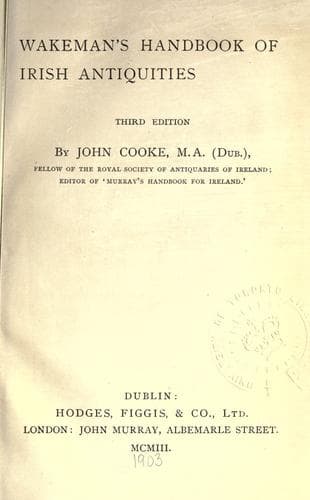
Wakeman's handbook of Irish antiquitiesWakeman, W. F. (William Frederick)
History
Wakeman's handbook of Irish antiquities
Wakeman, W. F. (William Frederick)
Ireland -- Antiquities
Of the exploration of Irish crannogs in recent years, that of
Moylarg, County Antrim, was carefully carried out under the personal
supervision of the Rev. Dr. Buick. The clearing laid bare a quantity
of well-constructed woodwork, showing a system of log-supports to the
piles, radiating beams, and uprights mortised into the base beams. ‘The
layers of branches, rushes, and bracken were tightly packed together;
stones large and small laid in between; and the whole well pinned down
by stakes of hazel about the thickness of a man’s leg. These stakes had
been pointed with a sharp metallic axe, three cuts as a rule sufficing
to complete the operation.’ The ‘finds’ consisted of over 250 pieces
of flint, mostly chips, an arrow-head, stone celt, a number of tracked
stones, whetstones, and quern remains; bones of the ox, goat, pig--all
broken for marrow--and red deer antlers; of bronze, a strainer of
fine type with iron handle, an ingot and its mould, and a few other
articles; four glass beads; fragments of leather: of pottery, a huge
number of pieces; of iron, an axe of gallowglas type, portion of a
mediæval lock, a chisel-like implement, nails, knife, half shears, and
spear-butt; a lead pendant of Late Celtic pattern, and portion of a
cross of ninth or tenth century type.[115] Similar operations have been
carried out recently by Dr. S. A. D’Arcy in several crannogs in the
neighbourhood of Clones. The ‘finds’ were numerous, and generally of
the various classes already described.[116]
An interesting discovery of a ‘submarine’ crannog was made by Mr. R. J.
Ussher, in 1879, at Ardmore. The action of the sea had washed away the
shingle, and exposed a double row of pile remains enclosing an oval
space measuring 100 feet in diameter. The stratum of turf was 9 feet
thick. The encroachment of the sea is due to the subsidence of the land
on the southern shores of Ireland well within the periods of human
occupation.[117]
Examples of what have been designated ‘Lake Stone-dwellings’ or ‘Stone
Crannogs,’ are to be found in the lake-riddled district of Connemara,
to which attention was called by Mr. G. H. Kinahan in 1872. These
islands have been wholly or in part formed of stones, and enclosed by
a wall similar to the cashel of the land fortification. That of Hag’s
Castle, in Lough Mask, with a thick encircling wall, is the largest
of the kind. Others exist in a lake on Goromna Island, in Lough Bola,
near Carna, and Lough Cam, near Roundstone Bay, and in Ballinafad
Lough, near Ballinahinch.[118] Mr. Layard has described those in Lough
Skannive, near Carna; but no exploration of their contents has yet been
attempted in any of these islands.[119]
Public-domain text, read in full here on John Shaqi.
Reviews
Reviews
No reviews yet
Be the first to share your thoughts on this work.
Elsewhere in the archive
Join the Discussion
Join the discussion
Sign in to leave a comment or review.
Sign InorCreate an account