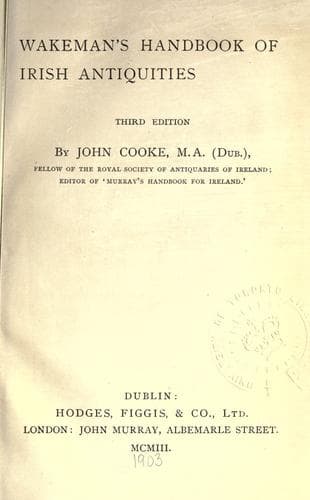
Wakeman's handbook of Irish antiquitiesWakeman, W. F. (William Frederick)
History
Wakeman's handbook of Irish antiquities
Wakeman, W. F. (William Frederick)
Ireland -- Antiquities
_Crannog Pottery._--The remains of fictile ware, discovered in
crannogs, afford an opportunity of comparing the pottery of the
lake-dwelling inhabitants with the urns used for sepulchral purposes,
which are found in the cairns, cists, and tumuli. The fragments found
in the lake-dwellings have been numerous; but, owing to the fragile
nature of the ware, no perfect example has yet been discovered.
They are larger than the cinerary urns and broader at the base. The
shoulders are provided with perforated ears, affording a means of
suspension by leather thong or withe. The colour of this ware varies
from light drab to extremely dark brown, though a few have been found
which were slightly red in appearance. The ornament which they usually
bear is a chevron, or a herring-line pattern, such as are often found
upon fictile ware discovered in sepulchral tumuli, as well as upon
several varieties of bronze celts and other weapons or instruments.
Others have dots and lines; but in general style and finish they are of
a much inferior type to the cinerary urns.
[Illustration: Cooking-Vessel from Lough Eyes, Co. Fermanagh.]
In no single instance has there been discovered a trace on crannog
pottery of what might be called Christian art or design. All the
earthen vessels of this class hitherto found were hand-made, and
appear to have been well burnt. They are invariably unglazed; and in
many examples the action of fire would seem to have been more intense
internally than on the exterior. The material is invariably sandy clay;
possibly the grit was added in order to afford greater consistency to
the paste. Most of the vessels show this sand distinctly; and in the
ruder specimens particles of white stone, occasionally the size of
a small pea, and sometimes no bigger than the head of a pin, may be
noticed roughly projecting from their sides. A number of flat discs of
the same material as the vessels were found with them, which seemed to
have been their covers or lids. A curious provision for the escape of
steam during the process of boiling or cooking is observable in some
of these earthen pots. It consists of a small circular aperture in the
neck or upper side of the vessel, just below the point where the lid
would be supported or caught. It is not possible to determine whether
these vessels, when entire, were invariably perforated or otherwise;
the aperture, however, occurs in some of the specimens preserved.
Vessels which were of this type and exact style of ornamentation
appear to be extremely rare; but they have been discovered in some
districts of North America, and in Indian burial mounds of remote
but unascertained date. The principal sources of this pottery in
Ireland were the crannogs of Ballydoolough, Drumgay, Lough Eyes,
Drumdarragh, and Lankhill, all in the county of Fermanagh; but valuable
specimens have been found at Lisnacroghera, and other places. As these
discoveries were subsequent to the compilation of Wilde’s _Catalogue_,
Public-domain text, read in full here on John Shaqi.
Reviews
Reviews
No reviews yet
Be the first to share your thoughts on this work.
Elsewhere in the archive
Join the Discussion
Join the discussion
Sign in to leave a comment or review.
Sign InorCreate an account