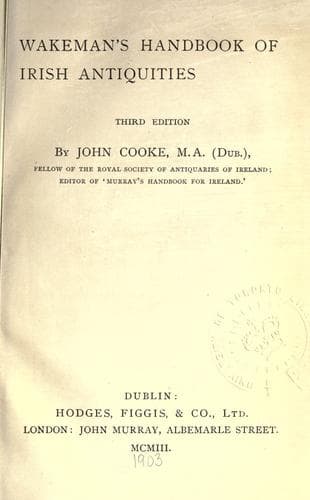
Wakeman's handbook of Irish antiquitiesWakeman, W. F. (William Frederick)
History
Wakeman's handbook of Irish antiquities
Wakeman, W. F. (William Frederick)
Ireland -- Antiquities
surroundings, it seemed quite hopeless to penetrate to any extent into
the mud or pulp in quest of discoveries.
Similar cases of ‘finds’ could be multiplied many times; it is
sufficient to state that in nearly every crannog hitherto discovered,
and more or less explored in Ireland, articles formed of flint or
stone, and similar in every respect to remains usually assigned to the
Stone Age, have occurred, and in apparent connection with implements
of bronze and iron. The necessity for the use of stone celts discovered
in the lake-dwellings is not clear; for it is certain that the long
clean cuts which appear on the ends of the pilings or stakes by which
the islands are encircled, could only have been made with sharp
metallic implements of the axe or adze kind. Such objects are very
common in crannog remains; and some have been found furnished with
well-steeled cutting edges, while the remainder of the head consisted
of soft iron. The mortice-holes so often found in the framework of the
islets, and in the larger timbers of the huts, were evidently worked
out by the use of metal chisels, which may have been formed either of
bronze or iron.
The huts of Drumkellin and Kilnamaddo are perhaps among the earliest
remains of lake-habitations yet found within the British Isles; but
whatever claim they may have for classification among the earliest
lake-dwellings of Central Europe, the Irish crannogs, as a whole, seem
to have no such claim. And as regards these huts, ‘the relics,’ as Dr.
Munro says, ‘are too few to justify such a sweeping conclusion as that
these dwellings were constructed at a period when metal implements
were unknown in the country. At any rate, there can be no reasonable
doubt that the period of greatest development of the Scotch and Irish
lake-dwellings was during the Iron Age, and at least as far posterior
to Roman civilization as that of the Swiss Pfahlbauten was anterior to
it.’[121]
* * * * *
Public-domain text, read in full here on John Shaqi.
Reviews
Reviews
No reviews yet
Be the first to share your thoughts on this work.
Elsewhere in the archive
Join the Discussion
Join the discussion
Sign in to leave a comment or review.
Sign InorCreate an account