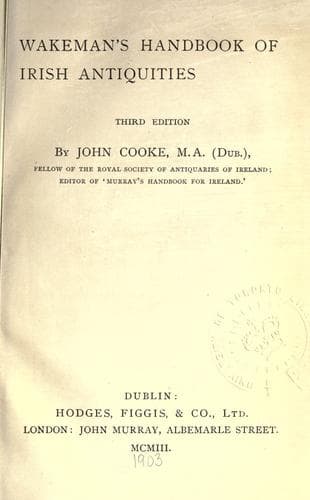
Wakeman's handbook of Irish antiquitiesWakeman, W. F. (William Frederick)
History
Wakeman's handbook of Irish antiquities
Wakeman, W. F. (William Frederick)
Ireland -- Antiquities
_Rahan._--One of the most remarkable remaining examples of this
style of church occurs at Rahan, near Tullamore, in the King’s
County.[125] The monastery was originally founded by St. Carthach,
afterwards bishop of Lismore, at the beginning of the sixth century.
A triple chancel arch, and a circular window, highly ornamented, are
the chief remaining details of the original building. The chancel is
stone-roofed; and the chamber above was lit by the circular window. The
piers of the arch are rounded off into semi-columns, with capitals of
very singular character, quite distinct from Norman work. The bases of
the semi-columns are globular in form; and the blocks are sculptured
in each compartment out of a single stone. The capitals or imposts are
ornamented upon their angles with human heads, the hair of which is
carried back and represented by shallow lines cut upon the face of the
stone in a very fanciful manner. The window, which is 7 feet 6 inches
in diameter, is composed of stones unequal in size, and displaying
chevron ornaments in very low relief.
[Illustration: Window at Killeshin.]
* * * * *
_The Rock of Cashel._--Grouped upon this celebrated Rock, which rises
precipitously from the plain to a height of about 300 feet, is one of
the most interesting collections of buildings in the British Isles.
Cashel was associated with the early kings of Munster; and we are told
a church was founded here by St. Declan in the time of St. Patrick. The
Annalists give the consecration of the chapel of Cormac Mac Carthy,
king of Munster, under the year 1134, thirty-seven years before the
date of the Anglo-Norman invasion. The buildings, in addition, consist
of the Cathedral, founded by Donagh O’Brien, king of Thomond, about
1152, which suffered many vicissitudes, and the Round Tower. A portion
was constructed for defensive purposes, constituting what is called the
Archbishop’s Castle. There is a much-worn cross with an effigy of St.
Patrick; and the ruins of Hore Abbey, founded for the Cistercians in
1272, stand at the foot of the Rock.
[Illustration: The Rock of Cashel.]
Cormac’s Chapel is, with the exception of the round tower, the most
ancient structure of the group. It is not parallel with the Cathedral,
and therefore differs in orientation. It is roofed with stone, and in
its capitals, arches, and other features and details, is distinctly
Irish-Romanesque in style.
[Illustration: Interior view of King Cormac’s Chapel.]
Public-domain text, read in full here on John Shaqi.
Reviews
Reviews
No reviews yet
Be the first to share your thoughts on this work.
Elsewhere in the archive
Join the Discussion
Join the discussion
Sign in to leave a comment or review.
Sign InorCreate an account