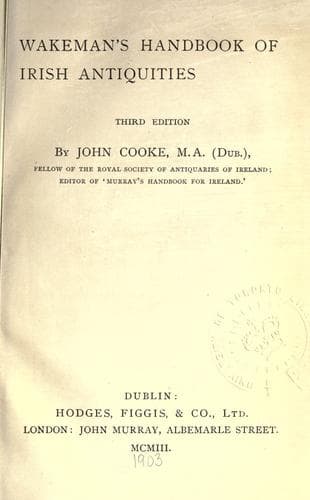
Wakeman's handbook of Irish antiquitiesWakeman, W. F. (William Frederick)
History
Wakeman's handbook of Irish antiquities
Wakeman, W. F. (William Frederick)
Ireland -- Antiquities
The doorways of Cormac’s chapel are three in number--one in the centre
of the west end, and one in each of the side-walls of the nave,
within a few feet of the west gable. The north and south doorways are
original, and are headed with a carved tympanum or lintel between
the aperture and the decorated semicircular arches above. They are
both exceedingly rich in sculpture; but the north doorway appears to
have been the chief entrance, as it is considerably larger and more
highly decorated than the other. It is surmounted by a canopy; and the
tympanum is sculptured with a very singular device, representing a
combat between a centaur, armed with bow and arrow, and a huge animal,
probably intended for a lion. The head of the centaur is covered by a
conical helmet with a nasal, and he is shooting a barbed arrow into
the breast of the lion. A small animal beneath the feet of the latter
appears to have been slain in the encounter. The west doorway, which is
of a later date, is not canopied, and its tympanum is sculptured with a
single animal, not unlike the lion upon the other.
* * * * *
[Illustration: Doorway at Freshford, Co. Kilkenny.]
_Freshford._--The doorway at the church of St. Lactan, Freshford, Co.
Kilkenny, is one of the most beautiful now existing in Ireland; it is
‘almost classical,’ says Brash, ‘in the symmetry and chasteness of its
details.’ The original church was erected in the seventh century; and,
in Petrie’s opinion, it was rebuilt about the close of the eleventh
or the beginning of the twelfth century. The doorway consists of a
series of recessed arches richly decorated, in which the bead and
chevron mouldings are conspicuous. On each side of the spring of the
external arch is a piece of sculpture, much worn; one is that of a man
on horseback, and the other that of two standing figures; above the
imposts are grotesque lions’ heads. Two inscriptions are over the inner
arch; that on the under band runs thus: ‘A prayer for Niam, daughter of
Corc, and for Mathgamain O’Chiarmeic, by whom was made this church.’ On
the upper band is--‘A prayer for Gille Mocholmoc O’Cencucain who made
it.’ The latter was, no doubt, the architect, and the former the patron
at whose expense the work was carried out.
Other remarkable examples of Irish-Romanesque architecture are Aghadoe
(_circa_ 1158), Tuam (1161), Clonfert (1166), and Devorgilla’s Church,
Clonmacnoise (1168). The chancel-arch in Tuam Cathedral, and the
doorway of Clonfert, are among the finest of their kind now remaining
of the period.
CHAPTER XII.
CROSSES.
VARIETIES OF EARLY CROSSES--EXAMPLES AT CLONMACNOISE--HIGH CROSSES--
THE HIGH CROSSES AT MONASTERBOICE--THEIR SCULPTURE AND
DECORATIONS--SEPULCHRAL SLABS--EARLY GRAVES.
Public-domain text, read in full here on John Shaqi.
Reviews
Reviews
No reviews yet
Be the first to share your thoughts on this work.
Elsewhere in the archive
Join the Discussion
Join the discussion
Sign in to leave a comment or review.
Sign InorCreate an account