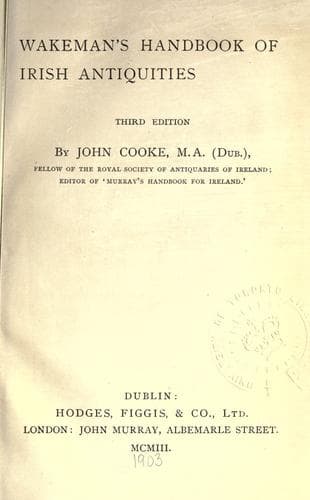
Wakeman's handbook of Irish antiquitiesWakeman, W. F. (William Frederick)
History
Wakeman's handbook of Irish antiquities
Wakeman, W. F. (William Frederick)
Ireland -- Antiquities
An early monumental stone remains in the cemetery, a few yards to
the north of the less ancient church. The inscription is in the Irish
language and character, and reads in English, ‘A prayer for Ruarchan.’
A simple flagstone, inscribed with a name, and sculptured with the
sacred symbol of Christianity, such as the early Christians were
accustomed to place over the grave of an eminent man, forms a striking
contrast to the tablets which too often disfigure the walls of our
cathedral and parish churches. Many remains of this class lie scattered
among the ancient and often-neglected graveyards of Ireland; but they
are every day becoming more rare, as the country stone-cutters, by whom
they are regarded with but slight veneration, frequently form out of
their materials modern tombstones, defacing the ancient inscriptions. A
characteristic example of a portion of an inscribed slab is here given;
it is from Iniscaltra, an island in Lough Derg, for many centuries a
celebrated burial-ground.
In several cemeteries found in connection with the earlier monastic
establishments of Ireland, graves frequently occur, formed of flat
stones placed edgeways in an oblong figure and covered with large
flags, after the pagan fashion. Were it not that in several instances
the stones at either end of the enclosure have been sculptured with a
cross, they might be supposed to indicate the site of a pagan cemetery,
which the early Christians, for obvious reasons, had hallowed by the
erection of a _cill_. The direction of the grave is generally east and
west; but in the cemetery adjoining the very early church at Saint
John’s Point, in Co. Down, and at Kilnasaggart, the graves are arranged
in the form of a circle, to the centre of which the feet of the dead
converge.
[Illustration: Plan of Cemetery, Kilnasaggart, near Jonesborough, Co.
Armagh.]
The cemetery at Kilnasaggart consists, as the plan here shows, of two
concentric circles of low flat graves radiating towards the centre,
at which stands a small pillar-stone. The outer circle is 55 feet in
diameter, and at the north edge is the well-known Pillar-stone. This
originally contained an Ogam inscription, which was defaced, probably
when converted to Christian uses. It has a number of incised crosses,
and an Irish inscription to St. Ternoe.[126]
A similar mode of interment, which occurs at Town-y-Chapel, near
Holyhead, in Wales, is referred to in the _Archæological Journal_, vol.
iii.; and it is worthy of remark that the place where the graves are
found appears to have been the scene of a battle, fought about A.D.
450, in which many Irishmen were slain.
CHAPTER XIII.
ROUND TOWERS.
OPINIONS FORMERLY CURRENT WITH REGARD TO THE ORIGIN AND USES OF
THE ROUND TOWERS--THEIR CHARACTERISTICS--DOORWAYS, WINDOWS AND
APERTURES--EXAMPLES AT CLONDALKIN, MONASTERBOICE, KILDARE,
DEVENISH.
Public-domain text, read in full here on John Shaqi.
Reviews
Reviews
No reviews yet
Be the first to share your thoughts on this work.
Elsewhere in the archive
Join the Discussion
Join the discussion
Sign in to leave a comment or review.
Sign InorCreate an account