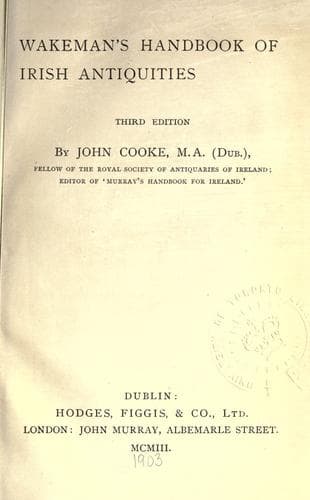
Wakeman's handbook of Irish antiquitiesWakeman, W. F. (William Frederick)
History
Wakeman's handbook of Irish antiquities
Wakeman, W. F. (William Frederick)
Ireland -- Antiquities
Round towers of about 18 feet in external diameter, and varying in
height from 60 to about 110 feet, are frequently found in connection
with the earlier monastic establishments of Ireland. The question of
their origin and uses long occupied much antiquarian attention. In
the seventeenth and eighteenth centuries they had been regarded by
archæologists as the work of the Danes; but towards the close of the
latter century General Vallancey propounded various theories, which
assumed them to be of Phœnician or Indo-Scythian origin, and to have
contained the sacred fire from whence all the fires in the kingdom
were annually rekindled. By those who affirmed their Christian origin
they were successively declared to be anchorite towers in imitation of
that of St. Simon Stylites, and penitential prisons, and thus theories
were multiplied until they became almost as numerous as the towers
themselves. Each succeeding writer, instead of elucidating, appeared to
involve the subject in deeper mystery than ever--a mystery that was
proverbial until dispelled by George Petrie in his great work on _The
Origin and Uses of the Round Towers of Ireland_, which was received,
with good cause for the effusion, as ‘the most learned, the most exact,
and the most important ever published upon the antiquities of the
ancient Irish nation.’
That the general conclusions embodied in this work were arrived at
after a long and patient investigation, not only of the architectural
peculiarities of the numerous round towers, but also of the
ecclesiastical structures usually found in connection with them, is
sufficiently shown by the many references to, and illustrations of,
examples scattered over the whole country. But Petrie also, with the
assistance of the best Celtic scholars in Ireland, sought in the
‘Annals’ and other Irish MSS. for references to such buildings as
it was the custom of the early inhabitants to erect; and from these
hitherto-neglected sources of information, much light was thrown upon
the subject of ancient Irish ecclesiastical architecture. The following
is a summary of Petrie’s conclusions:--
1. That the Irish ecclesiastics had, from a very early period, in
connection with their cathedral and abbey churches, campaniles or
detached belfries, called in the Irish ‘Annals’ and other ancient
authorities by the term _Cloictheach_, ‘House of a bell.’
2. That no other building, either round or square, suited to the
purpose of a belfry, has ever been found in connection with any church
of an age anterior to the twelfth century, with the single exception of
the square belfry attached to a church on Inis Clothrann or Clorin, an
island in Lough Ree, which seems to be of earlier date.
Public-domain text, read in full here on John Shaqi.
Reviews
Reviews
No reviews yet
Be the first to share your thoughts on this work.
Elsewhere in the archive
Join the Discussion
Join the discussion
Sign in to leave a comment or review.
Sign InorCreate an account