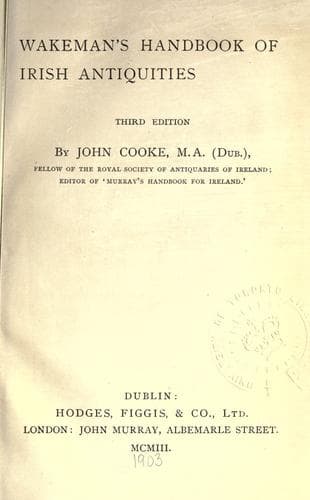
Wakeman's handbook of Irish antiquitiesWakeman, W. F. (William Frederick)
History
Wakeman's handbook of Irish antiquities
Wakeman, W. F. (William Frederick)
Ireland -- Antiquities
In Ireland they are generally associated with prehistoric remains,
and are occasionally found in connection with church buildings of the
earliest type. It is probable that, dating from prehistoric ages, they
were in time pressed, as it were, like the holy wells, into association
with Christian rites. The following are some of the many places
where holed-stones may be found in connection with our old churches:
Kilmalkedar, Co. Kerry; Castledermot, Co. Kildare; Inismurray, Co.
Sligo; Roscam, near Galway; Mainister, on Aran Mór, Co. Galway; Layde,
Co. Antrim; Holy Island, Lough Derg; Glendalough; and on the Island of
Devenish in Lough Erne, Co. Fermanagh.
We have perhaps lived beyond the age when legends referring to this
class of monument were still generally current. The virtue of the
Kilmalkedar stone was some fifty years ago equal in repute to that
conceded to the Stennis example, and even, in some respects, superior;
for, it was further firmly believed by many of the old inhabitants
of Kerry, that persons afflicted with chronic rheumatism, ‘falling
sickness,’ or some other ills, might, by passing three times round
it (with faith, and by the offering of certain prayers), be restored
to health. In the parish of Aghade, Co. Carlow, is a stone called
Cloghafoyle, the ‘Stone of the hole.’ ‘It projects in a semi-recumbent
position 7 feet 6 inches above ground, is 5 feet 8 inches in width,
1 foot 6 inches in its thickest part, and is pierced--nearly equally
distant from the sides and top--with a round hole 11½ inches in
diameter. Formerly children were passed through this aperture, either
as a cure for, or a preventive against, the malady called rickets.’[7]
A similar custom, as Colonel Wood-Martin points out, was observed at
St. Madron’s well in Cornwall, Minchen Hampton in Gloucestershire, and
Fyvie in Aberdeenshire.[8] A famous stone exists on Ardmore Strand,
Co. Waterford, beneath which pilgrims on St. Declan’s day (22nd Dec.)
crawled on completing their devotions.
Public-domain text, read in full here on John Shaqi.
Reviews
Reviews
No reviews yet
Be the first to share your thoughts on this work.
Join the Discussion
Join the discussion
Sign in to leave a comment or review.
Sign InorCreate an account