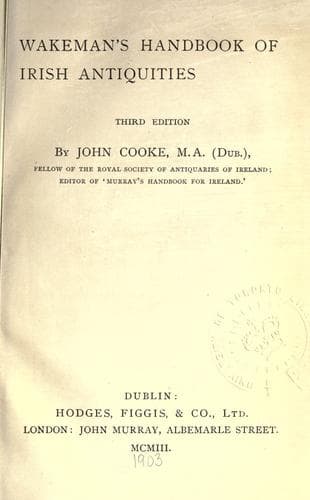
Wakeman's handbook of Irish antiquitiesWakeman, W. F. (William Frederick)
History
Wakeman's handbook of Irish antiquities
Wakeman, W. F. (William Frederick)
Ireland -- Antiquities
We have seen that in the Bronze Age a great advance had been
made in metal work among the Celtic tribes of Europe, showing
great technical skill, taste in design, and delicacy of touch in
manipulation--qualities not excelled in the early part of the
succeeding Christian period. The type of ornament which characterised
the Later Bronze Age and the Early Iron period seems to have flourished
longer in Ireland than elsewhere; and with the introduction of new
elements by Christianity, it found, in time, its expression, not only
in metal work, but in the stone work of ecclesiastical buildings, and
in the illumination of copies of the Scriptures. The latter flourished
especially, as we know, and the manuscripts which were executed by the
early scribes in Irish schools are the finest of the kind now existing.
* * * * *
_Bells._--With the introduction of Christianity came new needs; and
bells were among the first articles provided for ecclesiastical
purposes. Considering, as we have shown, the skill that had been
attained in metal work in pagan days, it is strange that the earliest
examples in Christian times were of a very rude kind. That no fine
example of metal work of the Christian period in Ireland can be
assigned to an earlier date than about the tenth century, may be due to
the fact that the country was repeatedly swept by Norse invaders, and
all such objects became their prey.
We read, in the Lives of St. Patrick, St. Columba, and others, of
the names of various artificers who made bells, crosses, crosiers,
and shrines for churches. Frequent mention is made of bells by the
Annalists. The early bells were of a peculiar quadrangular form,
and made of pieces of sheet-iron fastened together with rivets. The
oldest example of the kind in Ireland is the _Bell of St. Patrick_,
or Bell of Armagh, now in the Academy collection. It is of the rudest
description, and its antiquity apparent. The space between the edges
of the overlapping pieces seems to have been filled in with bronze to
give the body complete cohesion; and the whole coated with a thin layer
of a fusion of the same metal, which not only improved its tone, but
preserved it from decaying by rust. There is good reason to believe
that, as its name implies, it had belonged to St. Patrick himself.
For many ages it was one of the chief treasures preserved in Armagh;
here it was highly revered, so much so, that, about the year 1091,
it was enclosed in a magnificent and costly _Shrine_, which is also
preserved in the same collection. The bell had its own keeper, and
was handed down, as was the custom, from generation to generation in
the same family, with the most scrupulous regard for its safety. The
shrine, which is characteristic of the metal work of the period, is
formed of bronze plates, to which decorated panels are attached by
rivets. The front panel is divided into thirty-one spaces filled with
Public-domain text, read in full here on John Shaqi.
Reviews
Reviews
No reviews yet
Be the first to share your thoughts on this work.
Elsewhere in the archive
Join the Discussion
Join the discussion
Sign in to leave a comment or review.
Sign InorCreate an account