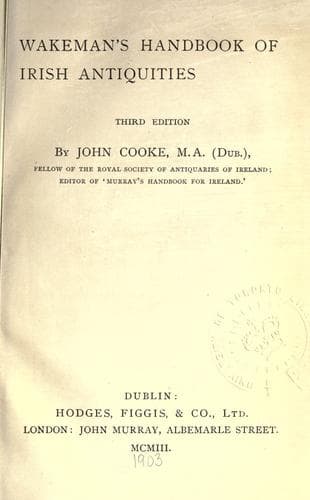
Wakeman's handbook of Irish antiquitiesWakeman, W. F. (William Frederick)
History
Wakeman's handbook of Irish antiquities
Wakeman, W. F. (William Frederick)
Ireland -- Antiquities
gold ornament, crystals, and jewels; the setting of the crystals is
evidently later work. The back consists of a fine and perfect silver
plate, in open fret pattern. The sides are of gilt bronze, with
open-work ornament of a highly complicated interlaced pattern. There
are two arms at the sides, pierced, with rings inserted; the arms have
a circular plate setting, and the spaces between them and the rims are
filled with heavily-plated gold ornament. The handle portion of the
shrine is highly ornamented with bird forms and interlaced design,
in different treatment from the faces and sides. The shrine bears
an inscription, in the Irish character and language, of which the
following is a translation:--‘A prayer for Domnall O’Loughlin, by whom
this Bell (or Bell-shrine) was made; and for Domnall, the successor
of Patrick, with whom it was made; and for Cathalan O’Maelchalland,
the keeper of the Bell; and for Cudulig O’Inmainen, with his sons, who
covered it.’
There are many other ancient iron bells in Ireland, examples of which
will be seen in the National Museum. Of bell shrines, several others
exist: that of St. Senan’s is in possession of Mr. Marcus Keene,
whose family have been the hereditary custodians of the Saint’s bell.
The shrine of St. Mura’s bell from Fahan, Co. Donegal, after various
wanderings and changing of hands, is now in the Wallace collection,
London.
[Illustration: Bell of Chumascach Mac Ailello.]
About the tenth century, iron gave place to bronze as the more
satisfactory material in metal for bells. The date of one example at
least is ascertained by an inscription on its outer surface. This is
the Bell of Chumascach, and is also from Armagh. It is 12 inches high
and 8 inches across the mouth, and is of cast bronze, but the handle
and clapper are of iron. It bears the following inscription in Irish:--
[Illustration]
(Pray for Chumascach, son of Ailello). The death of the person
mentioned in the inscription is recorded in the _Annals of the Four
Masters_ as occurring in A.D. 909.
* * * * *
_Cumdachs._--The copies of the Gospels and other sacred writings which
had been used by the early saints of Ireland were generally preserved
by their successors, enclosed in cases formed of yew or some wood
equally durable. Many of those cases were subsequently enshrined or
enclosed in boxes of silver, or of bronze, called _Cumdachs_, richly
plated with silver and occasionally gilt; and in several instances
a third case appears to have been added. Sir William Betham, in his
_Irish Antiquarian Researches_, describes several of those evidences
of early Irish piety still extant and remaining in a state of
preservation. There are two in Trinity College Library, the shrines of
the Book of Dimma, and the Book of Mulling.
Public-domain text, read in full here on John Shaqi.
Reviews
Reviews
No reviews yet
Be the first to share your thoughts on this work.
Elsewhere in the archive
Join the Discussion
Join the discussion
Sign in to leave a comment or review.
Sign InorCreate an account