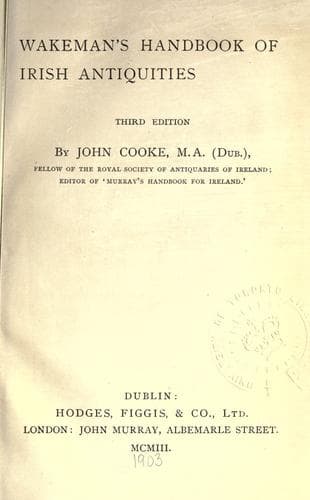
Wakeman's handbook of Irish antiquitiesWakeman, W. F. (William Frederick)
History
Wakeman's handbook of Irish antiquities
Wakeman, W. F. (William Frederick)
Ireland -- Antiquities
_Crosiers._--In like manner to the bells, the pastoral crooks and
crosiers which had belonged to the early fathers of the Irish Church,
appear to have been regarded as holy. Their possession was also
hereditary, and certain privileges, such as grants of land, were given
to the custodians. Notwithstanding the frequent pillage of church
property by the Danes, and the destruction of ‘superstitious’ relics
in a later time, numerous examples, remarkable for the beauty of their
decoration and the excellence of their workmanship, have been preserved
to our own day. The Irish crosier has simply the curved handle of a
staff, which seems originally to have belonged to a saint or founder of
a church, on which the metal covering was subsequently laid. It is not
the shepherd’s crook, so familiar as the emblem of episcopal office.
The crosier usually exhibits a profusion of ornament, consisting of
elaborately interwoven bands terminating generally in serpents’ heads,
or in some equally singular device. In several specimens occur settings
formed of stones or an artificial substance, variously coloured;
but this is supposed to indicate a comparatively recent date. The
continental type was probably introduced in the twelfth century, under
the influences already referred to in the foundation of monastic
establishments. A well-known example is the Crosier of Cashel, with
enamelled circular head and figure, one similar to which, and ascribed
to above period, is in the Cluny Museum, Paris.
An interesting and perhaps the oldest crosier in the Academy collection
is that of St. Berach of Termonbarry, which was handed down through
its hereditary custodians the O’Hanlys. The date of the Irish crosiers
is probably not earlier than the end of the tenth century. From the
inscription the crosier of Lismore, it doubtless dates about the
beginning of the twelfth century, during the time in which Niall Mac
Mic Aeducain, or Mac Gettigan, held the bishopric.
* * * * *
_The Cross of Cong._--This Cross is the chief gem of the Academy
collection, not only from its historical associations, but also as it
affords striking evidence of the advancement which the Irish artificers
had made in several of the arts, and in general manufacturing skill,
previous to the arrival of the English. It was made in Roscommon
by native Irishmen, about the year 1123, by order of King Turlough
O’Conor, father of Roderick, the last monarch of Ireland.
Public-domain text, read in full here on John Shaqi.
Reviews
Reviews
No reviews yet
Be the first to share your thoughts on this work.
Elsewhere in the archive
Join the Discussion
Join the discussion
Sign in to leave a comment or review.
Sign InorCreate an account