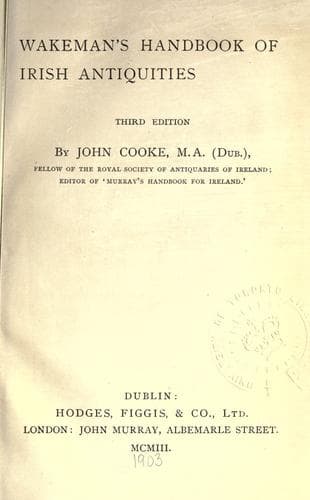
Wakeman's handbook of Irish antiquitiesWakeman, W. F. (William Frederick)
History
Wakeman's handbook of Irish antiquities
Wakeman, W. F. (William Frederick)
Ireland -- Antiquities
The Cathach appears to have been handed down from a very early period
in the O’Donnell family, of which St. Columba, the supposed writer of
the manuscript which it was made to enshrine, was a member. It was the
custom to wear it round the neck as a breastplate; and, before engaging
in warfare, it was exhibited in exhortation to the clan, and hence its
name the ‘Battler.’
The _Domnach Airgid_, also preserved in the Academy collection, is
a very interesting relic of the kind under notice. It contained a
considerable portion of the copy of the Gospels which was supposed to
have been used by St. Patrick during his mission in Ireland, and which
was presented by him to St. Mac Carthen. Unfortunately, when opened in
1832, the membranes of which the manuscript is composed had, through
the effects of time and neglect, become firmly attached to each other.
In 1892 the sheets were separated under the supervision of Dr. Maunde
Thompson of the British Museum, and examined by Dr. J. H. Bernard. It
was shown that the box was not made for the MS., being too small; and
the writing and text gave evidence that the copy was not earlier than
the eighth century.
The manuscript has three distinct covers: the first and most ancient
is of yew; the second of bronze plated with silver, of about the
eleventh or twelfth century; and the third of silver plated with gold,
dating about 1350. The outer and latest cover possesses many features
in common with that of the Cathach. It has an inscription to John
O’Karbri, who ordered it; and to John O’Barrdan, who made it. The
former, according to the _Annals of the Four Masters_, was abbot of
Clones, and died in 1353.[128]
_The Breac (Speckled) Moedoc_, from the Petrie collection, subsequently
passing to the Royal Irish Academy, is one of the most curious of the
ancient shrines. It is called after St. Moedoc, or Mogue, Bishop of
Ferns, and is supposed to have contained relics from Rome brought by
St. Molaise. It was preserved in Drumlane, County Cavan, until the
middle of the last century. It is valuable on account of the details
of ancient costumes which appear on eleven of the twenty-one figures
originally attached to its sides. These were gilt or plated with gold;
the case is bronze: the date is doubtful. A leather satchel which
contained it is also preserved in the National Museum.
* * * * *
Public-domain text, read in full here on John Shaqi.
Reviews
Reviews
No reviews yet
Be the first to share your thoughts on this work.
Elsewhere in the archive
Join the Discussion
Join the discussion
Sign in to leave a comment or review.
Sign InorCreate an account