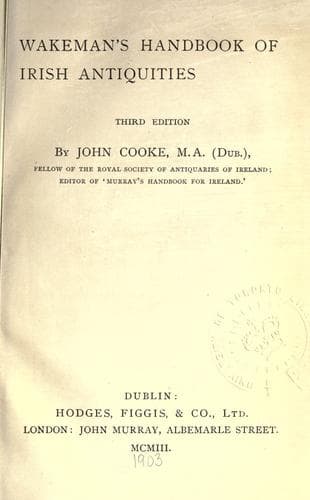
Wakeman's handbook of Irish antiquitiesWakeman, W. F. (William Frederick)
History
Wakeman's handbook of Irish antiquities
Wakeman, W. F. (William Frederick)
Ireland -- Antiquities
_Howth ‘Abbey.’_--The Church of St. Mary or Collegiate Church, more
commonly known as the ‘Abbey’ Church of Howth, stands near the edge
of a cliff, the base of which was formerly washed by the sea. The
original foundation is said to be by Sigtryg the Dane in 1042; and
a portion of this church still remains at the west entrance. This
was enlarged, chiefly by the addition of a north aisle in 1235 under
Archbishop Luke, on the removal of the prebendal church of Inis Mac
Nessan from Ireland’s Eye to the mainland, a grant of land having been
given by Almaricius, Lord of Howth, for this purpose. Placed upon a
precipitous bank, considerably elevated above the water’s edge, and
surrounded by a strong embattled wall, it presents a striking evidence
of the half-ecclesiastical, half-military character of the time.
Considerable additions were made to the east side in the fifteenth
century. The church was practically a two-aisled structure, the north
aisle being a little shorter than the south. The arches dividing the
aisles are six in number; and with the exception of the two adjoining
the east end, which are separated by an octagonal pillar, they spring
from rudely-formed quadrangular piers. The three to the west end denote
the earlier addition; those to the east are more pointed and show the
later extension. The porch in connection with the south doorway is a
very unusual feature in churches found in Ireland--a fact not easily to
be accounted for, as they appear to have been common in England during
mediæval times. A bell-turret with three apertures rose from the west
gable; the bells are said to be preserved in the castle.
A tomb usually ascribed to Christopher, the twentieth Lord of Howth,
who died in 1589, but which, from its style, is more probably that of
Christopher the thirteenth Lord (_d._ 1430), stands in the nave not
far from the east gable. It is a good specimen of the altar-tomb; but
an inscription which it bears, owing to the neglected state in which
the monument until lately was suffered to lie, has become illegible.
* * * * *
Public-domain text, read in full here on John Shaqi.
Reviews
Reviews
No reviews yet
Be the first to share your thoughts on this work.
Elsewhere in the archive
Join the Discussion
Join the discussion
Sign in to leave a comment or review.
Sign InorCreate an account