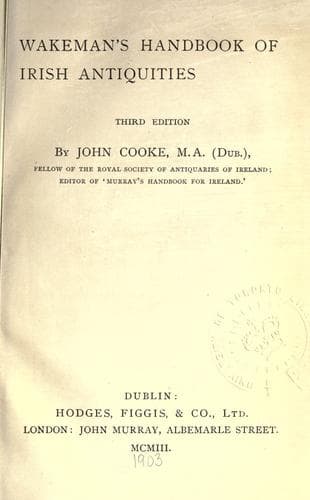
Wakeman's handbook of Irish antiquitiesWakeman, W. F. (William Frederick)
History
Wakeman's handbook of Irish antiquities
Wakeman, W. F. (William Frederick)
Ireland -- Antiquities
_St. Fintan’s._--The little church of St. Fintan, situated upon the
Hill of Howth, not far from the village of Sutton, cannot be of earlier
date than the ‘Abbey.’ This singular building measures upon the
interior but 16½ feet in length, by 7 feet 8 inches in breadth, yet it
contains five windows: one to the east, two to the south, one to the
north, and one in the west gable. These lights are of various forms:
that to the east has a semicircular head with a multifoil moulding; one
of the windows in the south wall is covered with a single stone, out of
which a semicircular arch-head is cut, while the other is quadrangular.
All the windows splay widely upon the interior. A doorway in the Lancet
form is placed in the west gable, which supports a bell-turret of
considerable dimensions, and strangely out of proportion to the size of
the structure. It contains one small Pointed aperture for the reception
of a bell. Of the origin of this church nothing is known; and there
were twelve saints of the name of Fintan; but the date is very fairly
indicated by its architectural peculiarities, which are characteristic
of the close of the thirteenth or early part of the fourteenth century.
There is a very ancient church remaining on Ireland’s Eye, a romantic
islet, or rock, lying off the North side of Howth. The place was
formerly known as _Inis-mac-Nessan_, from the three sons of Nessan,
viz. Dicholla, Munissa, and Nadsluagh, who some time in the seventh
century erected a little _Teampull_ or _Cill_; the remains of
Kilmacnessan still exist. It consists of a nave and chancel, and the
nave is 1 foot narrower at the west end than at the east. The doorway
has sloping jambs and a rounded head. An arch spanning the east end
formerly sustained a round tower belfry--a later addition, and a
curious feature, as the usual position is at the west end. The whole
building was so restored in the last century that it is impossible to
identify satisfactorily anything of the original structure.
FONTS.
A very considerable number of ancient baptismal fonts still remain
within the walls of the ruined churches of Ireland, and others are
found in graveyards where churches, of which no vestige remains,
formerly stood. The fonts usually found in connection with the more
ancient churches are extremely rude, and of small dimensions, being
rarely large enough to allow of the immersion of infants. They are
almost in every instance formed of a single stone, clumsily hollowed,
and having a hole at the bottom of the basin; but in some instances no
mode of escape for the water appears.
Public-domain text, read in full here on John Shaqi.
Reviews
Reviews
No reviews yet
Be the first to share your thoughts on this work.
Elsewhere in the archive
Join the Discussion
Join the discussion
Sign in to leave a comment or review.
Sign InorCreate an account