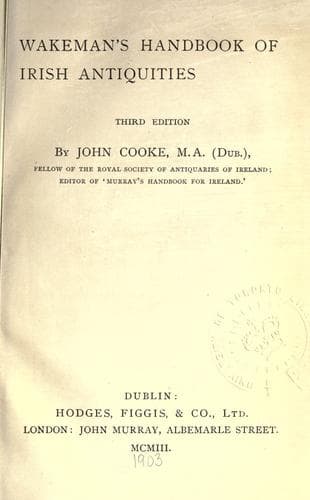
Wakeman's handbook of Irish antiquitiesWakeman, W. F. (William Frederick)
History
Wakeman's handbook of Irish antiquities
Wakeman, W. F. (William Frederick)
Ireland -- Antiquities
Portions yet remain of the walls and flanking towers of Athenry, in
the County Galway; but they are much dilapidated. One of the gateways
still stands, through which the road entering the town now runs. It was
originally defended by two towers, one of which has fallen; but the
other has been preserved by the insertion of an archway spanning the
road. In recent times it was with difficulty saved from destruction,
a road contractor desiring to have it for the sake of the material;
and that in one of the stoniest districts in Ireland. Concerning this
structure there was a tradition amongst the neighbouring people that
it was some time or other to fall upon the wisest man in Ireland. But
the selfish official who coveted the stones seems to have had no fear
on that account for his personal safety when passing beneath the arch,
and, in reply to a gentleman who strongly objected to the proposed
removal of the tower, on account of its interesting antiquity, he is
said to have scouted the idea, declaring that any antiquity it ever
possessed had gone long ago!
Kilmallock retains two of its four gates and much of its walls, which
are in a fair state of preservation, and date from the reign of
Edward III. These gates were very strong, and in times of need might
have served as castles. In Clonmel the west gate is the only one now
standing of four, and the remains of the walls surround the churchyard.
Of the walls and gateways of Galway but a few pieces stand. These dated
from 1270, and as late as 1651 the walls were perfect, with fourteen
towers and as many gateways. Little of the four gates and walls which
surrounded New Ross now remain; but one of the towers defending the
wall still stands.
The walls of Londonderry, the most perfect in Ireland, are
comparatively recent--they were raised in 1609--and have now seven
gates. The walls and towers of Limerick were of very early date, and
King John’s Castle is one of the finest Norman fortresses in the
kingdom. The north tower is the most ancient; and it still possesses
the original gateway. Since 1760, when the walls and ramparts were
abandoned as defences, they have been allowed to decay, and much of
them were removed for public convenience. A fine gateway may also
be seen at Carrickfergus Castle, showing all the usual defensive
appliances, portcullis, embrasures, and openings for dropping missiles
or molten lead. The keep is also perfect, and has walls 9 feet thick.
The citizens of Dublin, generally, are not aware that patches of their
old walls, including one gate or bar, still remain. The gateway is
called St. Audoen’s Arch, and may be seen close to the ancient church
of the same name. It is a fragment of an inner wall built by the
citizens during the invasion of Ireland by Edward Bruce, at a time
when he lay encamped at Castleknock, and daily threatened the city.
The adjoining portion of the wall is here high and strong; but the
gate-tower has been lowered almost down to its arch.
Public-domain text, read in full here on John Shaqi.
Reviews
Reviews
No reviews yet
Be the first to share your thoughts on this work.
Elsewhere in the archive
Join the Discussion
Join the discussion
Sign in to leave a comment or review.
Sign InorCreate an account