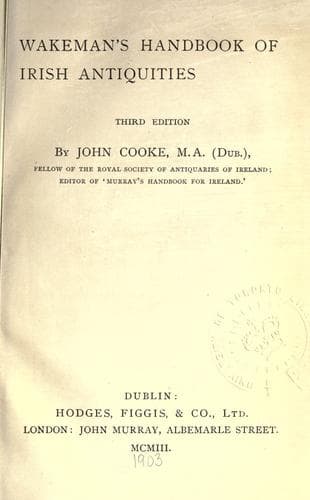
Wakeman's handbook of Irish antiquitiesWakeman, W. F. (William Frederick)
History
Wakeman's handbook of Irish antiquities
Wakeman, W. F. (William Frederick)
Ireland -- Antiquities
Of the structure whose origin is ascribed to Meyler Fitz Henry, but
completed by Archbishop Henry de Loundres, A.D. 1223, a portion may
possibly be concealed beneath the piles of modern edifices which
represent the present Castle of Dublin. The Castle presents little that
is of interest to the architectural antiquary, except he finds it in
the massive walls of the Record Tower, the oldest portion of the group
of buildings between the Castle yards.
* * * * *
_Bridges._--That the Irish at an early period were in the habit of
constructing bridges and causeways over rivers, or from the mainland
to an island, or from one island to another, is a fact recorded in the
‘Annals’; and we are not wholly without some existing remains of that
interesting class of structures. We read that in A.D. 1054 a bridge was
built over the Shannon, at Killaloe, by Turlogh O’Brien. This work was
no doubt of timber. It had probably been long decayed or destroyed when
Richard de Clare obtained possession of the greater part of that county
which still bears his name. But the ford was not so easily obliterated,
and Killaloe was for a considerable time called ‘Claresford’ by the
English. The little island of Begerin, near Wexford, was formerly
connected with another island by a causeway, described by Mr. G. H.
Kinahan as consisting of two rows of oak piles, set four feet apart,
with about five feet between each pair. ‘On these piles,’ he remarks,
‘there would seem to have originally been longitudinal and transverse
beams.’[131] St. Ibar, who died in A.D. 500, had a church and monastery
in Begerin, so that there is every probability that this bridge or
causeway may be referred to a very early date. The islands of Devenish
and Inismacsaint, in Lough Erne, both of which were monastic sites in
the sixth century, had similar communications with the mainland. A
number of the piles at the latter island may still be seen when the
water is low. Many of the lake-dwellings, or crannogs, were, as we have
seen, furnished with causeways connecting them with the mainland, or
with neighbouring islets.
Public-domain text, read in full here on John Shaqi.
Reviews
Reviews
No reviews yet
Be the first to share your thoughts on this work.
Elsewhere in the archive
Join the Discussion
Join the discussion
Sign in to leave a comment or review.
Sign InorCreate an account