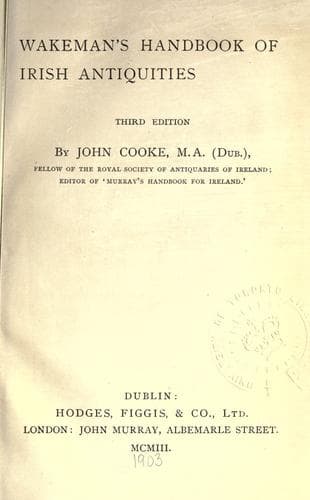
Wakeman's handbook of Irish antiquitiesWakeman, W. F. (William Frederick)
History
Wakeman's handbook of Irish antiquities
Wakeman, W. F. (William Frederick)
Ireland -- Antiquities
[14] _Ibid._, 1883–4, p. 222; 1887–8, p. 427.
[15] _Ibid._, 1879–82, p. 552.
[16] _Ibid._, 1874–5, p. 445.
[17] The cave is known by the name ‘Gillie’s Hole,’ and was used as
a retreat, about a hundred years ago, by a pair of lovers who, in
consequence of an imprudent marriage, had been discarded by their
friends. Such is the local legend.
[18] _Journal_ Roy. Soc. of Antiq. Ir., 1895, p. 64.
[19] April, 1865.
[20] _Journal_ Roy. Soc. of Antiq. Ir., 1883, p. 174.
[21] This--the Royal Society of Antiquaries--collection has been
transferred, with the exception of objects of a local interest, to the
National Museum, Kildare-street, Dublin.
[22] _Journal_ Roy. Soc. of Antiq. Ir., 1874–5, note, p. 281.
[23] _Journal_ Roy. Soc. of Antiq. Ir., 1868–9, p. 349.
[24] _Ibid._, 1874–5, p. 460.
[25] _Prehistoric Scotland_, p. 279.
[26] Mr. G. A. Lebour, in _Nature_, May 9th, 1872, speaking of
the character of the principal dolmens and cist-bearing mounds of
Finisterre, says that ‘in most cases in that department the dolmens
occupy situations in every respect similar to those in which the
tumuli are found, so that meteorological, and indeed every other
but human, agencies must have affected both in the same manner and
degree. Notwithstanding this, the dolmens are invariably bare, and the
cists are as constantly covered; there are no signs of even incipient
degradation and denudation in the latter, and none of former covering
in the first.’
[27] _Dolmens of Ireland_, p. viii.
[28] _Ibid._, p. 430.
[29] _Dolmens of Ireland_, vol. i., p. 8.
[30] _Maol_ may be interpreted ‘servant of.’
[31] Some doubt has been thrown on the story as told in the ‘Annals’:
see _Journal_ Roy. Soc. of Antiq. Ir., 1897, p. 430.
[32] The Rev. Maxwell Close makes the dimensions 12¼ feet by 9¼ feet,
and 5¾ feet thick.
[33] _Proceedings_ Roy. Ir. Acad., 3rd Series, vol. v., No. 3.
[34] The three distinct groups of rocks on the Three-Rock Mountain, a
familiar natural feature from the suburbs of Dublin, were considered by
Beranger to be ‘Druidical remains.’ From a distance they appear like
cairns, but they were never raised by human hands, and their interest
is entirely geological.
[35] _Journal_ Roy. Soc. of Antiq. Ir., 1896, p. 93; and 1876, p. 95.
[36] _Journal_ Roy. Soc. of Antiq. Ir., 1872, p. 523.
[37] _Journal_ Roy. Soc. Antiq., 1872, p. 526.
[38] _Ecclesiastical Architecture_, p. 97.
[39] See _Archæologia_, vol. xxv., p. 233.
[40] _Schliemann’s Excavations_, by Dr. C. Schuchhardt (1891), p. 147.
[41] _The Mycenæan Age_, by Dr. Christos Tsountas and Mr. J. Irving
Manatt (1897), p. 138.
[42] See _Proceedings_ Roy. Ir. Acad., vol. ix.
[43] _Proceedings_ Roy. Ir. Acad., vol. xxvii. (1892–93).
[44] _Rude Stone Monuments_, p. 219.
[45] The MSS. only state that the Ollamh was buried at Taillten.
[46] _Schliemann’s Excavations_, p. 151.
[47] _Egyptian Decorative Art_, chap. ii.
[48] _Journal of Hellenic Studies_, xiv., p. 329.
Public-domain text, read in full here on John Shaqi.
Reviews
Reviews
No reviews yet
Be the first to share your thoughts on this work.
Elsewhere in the archive
Join the Discussion
Join the discussion
Sign in to leave a comment or review.
Sign InorCreate an account