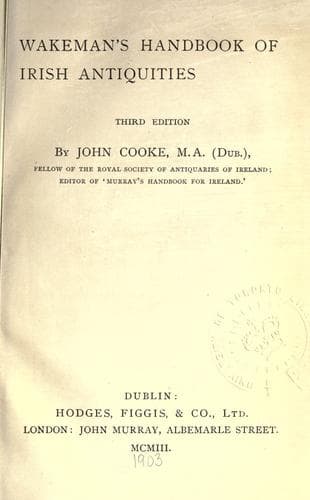
Wakeman's handbook of Irish antiquitiesWakeman, W. F. (William Frederick)
History
Wakeman's handbook of Irish antiquities
Wakeman, W. F. (William Frederick)
Ireland -- Antiquities
[49] See _Journal_, 1894, 1895; also _Trans._ Roy. Ir. Acad., vol. xxx.
pt. 1, xxxi. pt. 2.
[50] A somewhat similar example occurs in the sepulchral monument at
Glenmalin, Co. Donegal. See _Journal_ Roy. Soc. Antiq. Ir., 1890, p.
264.
[51] _Rude Stone Monuments of Sligo_, p. 136.
[52] _Catalogue of Antiq._, p. 27.
[53] See _Journal_, R. S. A. I., 1870, p. 579.
[54] _Politics_, Bk. iv., Ch. 2.
[55] _Murray’s Handbook of Ireland_ (1902), p. 350.
[56] See _Reliquary and Illustrated Archæologist_, vol. i., p. 35.
[57] _British Barrows_, p. 19.
[58] _Rambles and Studies in Bosnia-Herzegovina and Dalmatia_, pp. 132,
133.
[59] _Ibid._, p. 400.
[60] _Journal_ Roy. Soc. of Antiq. Ir., 1852–3, p. 295.
[61] _Pagan Ireland_, p. 108.
[62] _Journal_ Roy. Soc. of Antiq. Ir., 1876–8, p. 178.
[63] _Primeval Antiquities of Denmark_, p. 96.
[64] _The Civilization of Sweden in Heathen Times_, p. 32.
[65] _Schliemann’s Excavations_, by Dr. Schuchhardt, p. 86.
[66] _Early Age of Greece_, by W. Ridgeway, p. 495.
[67] _Early Age of Greece_, by W. Ridgeway, p. 495.
[68] _Annals of the Four Masters_, A.D. 537.
[69] _Ibid._
[70] _Ibid._, A.D. 458.
[71] _Manners and Customs of the Ancient Irish_, O’Curry; Introduction,
p. cccxl.
[72] Dr. Sullivan was of opinion that these words are used here in
the sense of funeral pyre; but this is not accepted, as strictly they
are applied to the whole funeral rite, especially to the reciting of
dirges, and the performance of games. See _Manners and Customs of the
Ancient Irish_, vol. i., cccxxiii.
[73] O’Curry, _Manners and Customs_, III. 176.
[74] _Ogam Inscribed Monuments of the Gaedhil_, Richard Rolt Brash, p.
13.
[75] _Irish Names of Places_, vol. i., p. 262.
[76] _Ogam Inscribed Monuments_, R. R. Brash, pp. 99–101.
[77] _Journal_ Roy. Soc. of Antiq. Ir., 1898, p. 1 (Rev. Canon Lett,
M.A.).
[78] _Journal_ R.S.A.I., 1885, p. 362.
[79] _Prehistoric Scotland_, p. 352.
[80] For a full account of this structure see a Paper by the Rev.
William Falkiner, M.A., _Proc._ R.I.A., vol. v., 3rd series, p. 211.
[81] _Journal_ Roy. Soc. of Antiq. Ir., 1860, p. 222.
[82] For an interesting account of this fort by Mr. P. J. Lynch, see
_Journal_ Roy. Soc. of Antiq. Ir., 1899, p. 5.
[83] _Journal_ R.S.A.I., 1893, p. 281; 1896, pp. 142, 363; 1897, p. 116.
[84] See _Journal_ Roy. Soc. of Antiq. Ir., 1898, p. 325, for notes and
admirable plan, by Mr. P. J. Lynch.
[85] Mr. Stewart Macalister says this should be Cathair na Mairtinech,
the ‘Fort of the Martins.’
[86] _Manners and Customs of the Ancient Irish_, iii., pp. 56–72.
[87] _Trans._ Roy. Ir. Acad., vol. xxxi., pt. vii., p. 334.
[88] _Eccles. Arch._, p. 445 _et seq._
[89] Donough Cairbreach O’Brien (d. 1242) built a rath, and Brian Boru
repaired many of the forts of Munster in his own lifetime.
[90] _Scientific Transactions_, Roy. Dub. Soc, vol. i., 2nd ser., p.
200.
[91] _Catalogue_ R.I.A., p. 254; _Journal_ Roy. Soc. of Antiq. Ir.,
1885, p. 126.
Public-domain text, read in full here on John Shaqi.
Reviews
Reviews
No reviews yet
Be the first to share your thoughts on this work.
Elsewhere in the archive
Join the Discussion
Join the discussion
Sign in to leave a comment or review.
Sign InorCreate an account