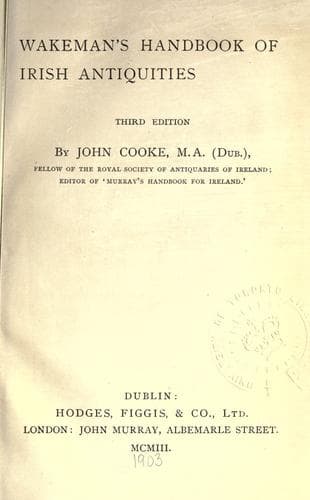
Wakeman's handbook of Irish antiquitiesWakeman, W. F. (William Frederick)
History
Wakeman's handbook of Irish antiquities
Wakeman, W. F. (William Frederick)
Ireland -- Antiquities
Important examples of rude sculpturings appear upon the walls of
certain natural, or perhaps semi-artificial, caverns occurring at
Knockmore, close to the village of Derrygonnelly, Co. Fermanagh. The
chief of these is the ‘Lettered Cave,’ so called from the carvings
of an early date with which its sides are scored. The dimensions of
this singular retreat are as follows:--Height, at the mouth, 10 feet 5
inches; these proportions gradually lessen to a distance of about 18
feet from the external opening. There the passage takes an oblique
turning to the southward, and continues to a distance of about 9 feet
further into the heart of the limestone. The height of the chamber at
its extreme end is about 5 feet. The opening faces north-east, and is
well sheltered from the wind by a grassy knoll, which extends, right
and left, in front. There is every reason to believe it was long used
as a habitation or place of retreat. The markings are placed, without
any attempt at symmetrical arrangement, upon almost every smooth
portion of the rocky surface of the interior. Many are extremely well
marked; others have become all but obliterated through the influence
of time, the efflorescence of the stone, and the action of persons who
have in many places scraped away the ancient figurings, or portions of
them, in order to find space for inscribing their respective names;
but, nevertheless, a considerable portion of the old markings remain in
excellent condition. These scribings consist for the greater part of
a number of figures and designs usually considered, by archæologists,
as prehistoric. But whatever may be the age and character of
such carvings, there can be no doubt amongst antiquaries that an
elaborately-formed interlacing cross, which may be seen engraved upon
the left-hand side of the entrance to the cave, must be referred to an
early Christian period.
Knockmore contains on its northern side, in a situation rather
difficult of access, a second scored and partially artificial cavern.
This little eyry, which is only large enough to retain in a recumbent
position two, or at most three, persons of ordinary size, must, while
yet the slopes of the knock were covered with trees and brushwood,
have formed a very secure retreat. That it was inhabited in early days
is certain, as upon digging up a considerable portion of the floor,
indications of fires having been used were traceable on at least
three separate levels. At a little distance from the surface, amongst
burnt-looking earth and particles of wood charcoal, Mr. Wakeman found
some bones of animals which had been used as food. They were generally
very small, and difficult of identification, but amongst them occurred
those of the red deer. The carvings here are rather of an elaborate
character, and form an interesting combination of the older style of
sepulchral rock-sculpture with what is generally considered early Irish
work, but of a period subsequent to the spread of Christianity in this
country.[17]
Public-domain text, read in full here on John Shaqi.
Reviews
Reviews
No reviews yet
Be the first to share your thoughts on this work.
Join the Discussion
Join the discussion
Sign in to leave a comment or review.
Sign InorCreate an account