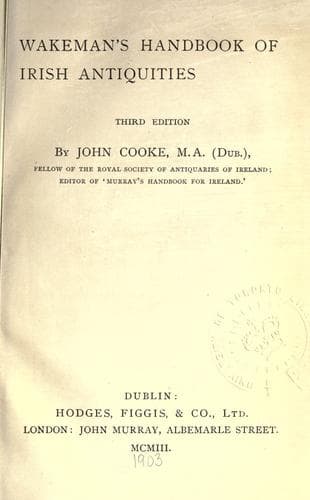
Wakeman's handbook of Irish antiquitiesWakeman, W. F. (William Frederick)
History
Wakeman's handbook of Irish antiquities
Wakeman, W. F. (William Frederick)
Ireland -- Antiquities
As we have already intimated, in the present state of our knowledge it
is impossible to dogmatize upon rock markings. Caution must be used in
any attempt to interpret them. Many are no doubt due to natural causes.
The familiar water-marks on the Old Red Sandstone formation may too
readily be taken for cuttings made by the hand of man. The late Richard
Rolt Brash once observed, in the sections of vertical rock strata in
the quarries of South Wales, cup-like holes, with corresponding bosses
on the opposing layers, and was of opinion that these were sometimes
taken for artificial hollows. The late Dr. Frazer, following on the
lines of M. Valenciennes, found the _Echinus lividus_ lodged in a
cup-like hollow burrowed for itself in the rocks on the sea-shore of
Bundoran. Dr. Frazer expressed his opinion that the cup-markings on the
rocks round the shore of Lough Melvin, once probably an arm of the sea,
were due to the same cause; and further, that some of the markings on
rocks described by Sir James Simpson in _British Archaic Sculpturings_
were pittings of the _Echinus_.[18] Many of the cup-like indentations
in the limestone rock are, in the opinion of some scientists, due to
acid secretions of the snail, notably the _Helix aspersa_. Making due
allowance for these natural causes, yet a mass of rude markings by
the hand of man remain, difficult to interpret as to their origin,
their meaning, and the people to whom they are to be assigned. In many
districts of this country, and some of them widely apart, we find
upon the sides of caves and rocks, and within the enclosure of pagan
sepulchral tumuli, a certain well-defined class of markings, often
arranged in groups, and with few exceptions, presenting what may be
styled a family type: we can hardly imagine them to be the result of
caprice. In ancient and in modern times, men confined by necessity to
a listless existence, in an inhospitable district, or when tending
flocks and herds, might very naturally have beguiled their hours by
carving with a stone or metallic instrument such figures as their fancy
prompted, upon the nearest object which happened to present a surface
more or less smooth. Scorings or patterns made under such circumstances
would be, in character, as various as the skill or humours of the
designers.
* * * * *
Public-domain text, read in full here on John Shaqi.
Reviews
Reviews
No reviews yet
Be the first to share your thoughts on this work.
Join the Discussion
Join the discussion
Sign in to leave a comment or review.
Sign InorCreate an account