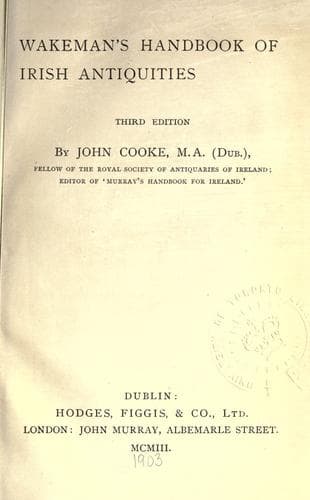
Wakeman's handbook of Irish antiquitiesWakeman, W. F. (William Frederick)
History
Wakeman's handbook of Irish antiquities
Wakeman, W. F. (William Frederick)
Ireland -- Antiquities
The work here consists of a continuous series of straight scorings,
accompanied by a number of dots or depressions more or less circular in
form. There can be no doubt that a generic resemblance may be noticed
between them and many of the markings of the Lennan inscription. This,
if there were nothing more, would raise a serious doubt of their being
merely accidental or capricious indentations. The great majority of
such irregular scorings should, nevertheless, be looked upon with
suspicion. Those which occur on the pillar-stone at Kilnasaggart,
Co. Armagh, though long considered to be Ogam characters, are now
universally pronounced to be nothing more than markings made by
persons who utilized the monument as a block for the sharpening and
pointing of tools or weapons. The same remark applies in full force
to certain scorings and scratches which disfigure a fine pillar-stone
standing close to the railway station of Kesh, County Fermanagh, on
the right-hand side of the line as you face towards Bundoran. They are
found abundantly on the coping stones of the walls of Londonderry, and
indeed in other localities too numerous to mention. At Killowen, County
Cork, they occur on a stone most significantly called Cloch na n’Arm,
or the ‘(Sharpening) Stone of the weapons.’
CHAPTER III
STONE MONUMENTS (_continued_): CHAMBERED TUMULI.
TUMULUS AT NEWGRANGE--TUMULUS AT DOWTH--TUMULUS AT KNOWTH--CAIRNS AT
LOUGHCREW--PREHISTORIC ORNAMENT.
In the _Senchas-na-Relec_, or ‘History of the Cemeteries,’ a tract in
the _Leabhar-na h-Uidhre_, we have a list of the regal cemeteries of
Erin during a long period prior to the advent of St. Patrick. This was
compiled at Clonmacnoise, and transcribed by Maelmuiri in the twelfth
century. In the opinion of Petrie the tract ‘must be referred to a
period several centuries earlier than that in which its transcriber
flourished.’[38] It says:--‘These were the chief cemeteries before the
Faith (_i.e._ before the introduction of Christianity), viz. Cruachu,
Brugh, Tailltiu, Luachair Ailbe, Oenach Ailbe, Oenach Culi, Oenach
Colmain, Temhair Erann.... At Tailltiu the kings of Ulster were used
to bury, viz. Ollamh Fodhla, with his descendants, down to Conchobhar,
who wished that he should be carried to a place between Slea and the
sea, with his face to the east, on account of the Faith which he had
embraced.’ In the same MS. there is also a poem ascribed to Dorban, a
poet of West Connaught, dealing with the deaths and burials of Dathi,
the last of the Milesian kings, and other princes of the race interred
at Rathcroghan. It contains three stanzas:--
‘Fifty mounds, I certify,
Are at Oenach na Cruachna,
There are under each mound of them
Fifty truly-fine warlike men.
The three cemeteries of the Idolaters are
The cemetery of Tailten, the select,
The cemetery of the ever-fair Cruachan,
And the cemetery of Brugh....
Public-domain text, read in full here on John Shaqi.
Reviews
Reviews
No reviews yet
Be the first to share your thoughts on this work.
Elsewhere in the archive
Join the Discussion
Join the discussion
Sign in to leave a comment or review.
Sign InorCreate an account