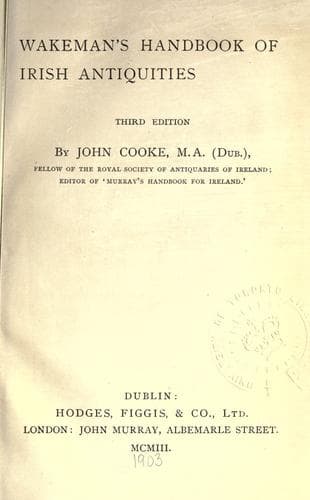
Wakeman's handbook of Irish antiquitiesWakeman, W. F. (William Frederick)
History
Wakeman's handbook of Irish antiquities
Wakeman, W. F. (William Frederick)
Ireland -- Antiquities
_Slievemore Cromlech._--Similar markings may be observed on one of
the upright stones of a ruined cromlech standing on the slope of
Slievemore, island of Achill, amongst other remains, styled on the
Ordnance sheet tumulus, cromlech, Danish ditch, respectively. It
is difficult to imagine that the likeness between these two sets
of cup-markings is accidental. A similar array of four cups, but
placed vertically, may be seen on one of the enormous stones forming
the right-hand side of the gallery leading into the great cairn of
Newgrange.
* * * * *
_Lennan Cromlech._--The inscribed cromlech of Lennan or Tullycorbet,
Co. Monaghan, stands upon a knoll called by the people of the district
Cruck-na-clia, which may be translated ‘Battle hill.’ This monument,
a fine one of its class, presents every appearance of having always
been free-standing. It bears some extremely curious markings, into
the character of which the late Sir Samuel Ferguson made careful
examination.[36]
* * * * *
_Castlederg Cromlech._--This monument lies about three-quarters of a
mile to the north of the town of Castlederg, 140 yards to the east
of the old Strabane road, leading through Churchtown townland. The
principal cap-stone was dislodged many years ago by the owner of the
farm. ‘It appears,’ says Sir Samuel Ferguson, ‘that the structure had
previously been rendered insecure by a stone-mason, who had abstracted
one of the supporters for building purposes; and it was suggested that
the motive for casting down the cap-stone was an apprehension lest the
owner’s cattle, in rubbing or sheltering under it, might do themselves
a mischief. That the inscription was there at the time of the first
disclosure of the upper face of the support on which it is sculptured,
is the common and constant statement of the people of the country; but
the case rests more satisfactorily on the fact, wholly independent of
testimony, that a collateral covering stone remains _in situ_, and that
the line of scorings is prolonged underneath it into a position too
contracted for the use of a graving tool.’[37]
Public-domain text, read in full here on John Shaqi.
Reviews
Reviews
No reviews yet
Be the first to share your thoughts on this work.
Elsewhere in the archive
Join the Discussion
Join the discussion
Sign in to leave a comment or review.
Sign InorCreate an account