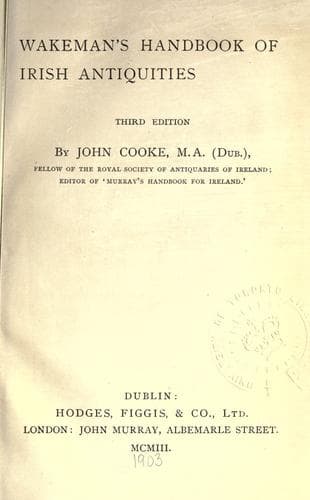
Wakeman's handbook of Irish antiquitiesWakeman, W. F. (William Frederick)
History
Wakeman's handbook of Irish antiquities
Wakeman, W. F. (William Frederick)
Ireland -- Antiquities
Among the trees between the mound of Dowth and the mansion are two
smaller tumuli. One of these is open from the top; it contains a
corbel-roofed chamber 10 feet in diameter and 8 feet high; round it are
five cells constructed of small flags set upright. A little to the east
of the house is a fine specimen of the ancient military encampment or
rath, one of the largest in Ireland.
* * * * *
_Tumulus at Knowth._--The other great tumulus (Knowth) of the Boyne
group has probably never been entered since the time, as the Annalists
tell us, it was plundered and doubtlessly much injured by the Danes.
It is nearly 700 feet in circumference, and between 40 and 50 feet
in height. For many years it has served as a convenient quarry for
builders of houses and repairers of roads. That it could be explored at
little cost is certain, as, owing to the denudation it has suffered,
the passage or gallery leading to its chamber has, in part, been laid
bare. Its circle or circles are not altogether obliterated; and here
and there some portions remain which show that the work, though less
massive than that of Newgrange, was at least as striking as anything to
be found in Dowth, or in connection with the remains at Loughcrew, or
others occurring in the western districts of Ireland.
Among the objects found about the tumuli Lhwyd mentions a gold coin
of Valentinian, said to have been discovered on the top of Newgrange;
Molyneux mentions a similar coin, and one of Theodosius, as being found
outside the cairn. A gold chain, two finger rings, and two gold torcs
were found in 1842 close to the entrance of Newgrange; and on further
search a denarius of Geta and two small brass, but defaced, coins were
also found. Too much caution cannot be used in considering these as
evidence in determining the date of the tumuli. A bronze pin, a ring
pin, and a small iron weapon were found in the chamber discovered in
Dowth in 1885. If, as seems certain, this chamber and passage are of
much later date than the tumulus itself, the presence of these objects
is easily accounted for. A discussion of the evidence upon which expert
opinion is based, as to the date of these monuments, is outside the
province of this book. It takes into consideration the character of the
architecture, the nature of the ornamentation, and the objects found.
Weighing these, the Boyne tumuli are assigned to the Early Bronze
Period, and Newgrange is considered the oldest of the group.
* * * * *
Public-domain text, read in full here on John Shaqi.
Reviews
Reviews
No reviews yet
Be the first to share your thoughts on this work.
Elsewhere in the archive
Join the Discussion
Join the discussion
Sign in to leave a comment or review.
Sign InorCreate an account