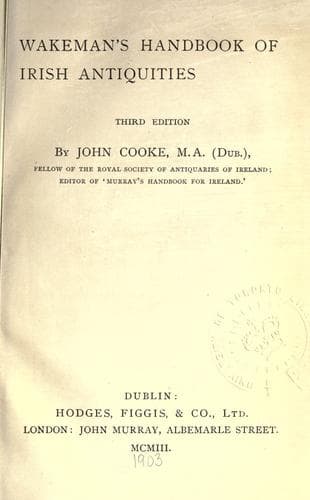
Wakeman's handbook of Irish antiquitiesWakeman, W. F. (William Frederick)
History
Wakeman's handbook of Irish antiquities
Wakeman, W. F. (William Frederick)
Ireland -- Antiquities
_Cairns at Loughcrew._--Loughcrew is a range of picturesque hills,
three miles south-east of Oldcastle. The ridge of the range is
about two miles in extent, and there are three chief heights:
Slieve-na-Calliaghe, 904 feet; Patrickstown Hill, 885 feet; and
Carnbawn, 842 feet: but the name of the first is generally applied
to the whole range. Here, within the radius of a rifle-shot, may be
seen grouped together the most extraordinary collection of archaic
monuments to be found in the kingdom. These for the most part consist
of megalithic sepulchres surmounted by tumuli, and surrounded by stone
circles. These number ‘from 25 to 30 cairns, some of considerable size,
being 120 to 180 feet in diameter; others are much smaller, and some
are so nearly obliterated that their dimensions can hardly be now
ascertained.’ It is, we think, not too much to say that on the stones
among these cairns is found the greatest collection of rude prehistoric
scorings yet found in Ireland or, perhaps, in Europe.
Popular superstition has long attributed these cairns and other remains
to be the work of a witch named Cailleach Bhéartha, who, in attempting
a wild leap in the adjoining townland of Patrickstown, was unfortunate
enough to fall and break her neck. Nothing was known of the character
or contents of these cairns until 1858. In the autumn of that year
Mr. Wakeman measured and made plans of several of the remains, and
wrote a paper upon the subject, which was read in his name before
the Architectural Society of Oxford, by J. H. Parker. We are thus
particular in giving names and dates in connection with the _first_
public notice of the antiquities at Slieve-na-Calliaghe, as their
‘discovery’ was claimed and is still erroneously attributed to the late
Eugene Conwell. He, however, did great service to Irish archæology,
inasmuch as, with the liberal co-operation of the late J. L. W. Naper,
owner of the soil, he was enabled to clear out the majority of the
chambers, and investigate what had been left by former searchers of
their contents. An immense amount of _débris_ was removed, and stones
which had been buried for ages were brought to light. Many of the
latter are singularly carved, and some presented designs previously
unknown to archæologists. The result of Conwell’s investigations was
given in papers read before the Royal Irish Academy in 1864 and 1866,
accompanied with an index map of the cemetery, in which the letters
of the alphabet indicate the cairns.[42] These, however, were of a
sketchy nature, and the voluminous report, with the plans and sketches
which he had prepared, seems never to have been published. A series of
drawings of the incised markings on some of the stones of the chambers
were prepared by Du Noyer; these remained unpublished until recent
years, when a collection of seventy-six drawings and plans of six of
the cairns fell into the hands of the late Dr. W. Frazer, and were
reproduced by the Society of Antiquaries of Scotland.[43]
Public-domain text, read in full here on John Shaqi.
Reviews
Reviews
No reviews yet
Be the first to share your thoughts on this work.
Elsewhere in the archive
Join the Discussion
Join the discussion
Sign in to leave a comment or review.
Sign InorCreate an account