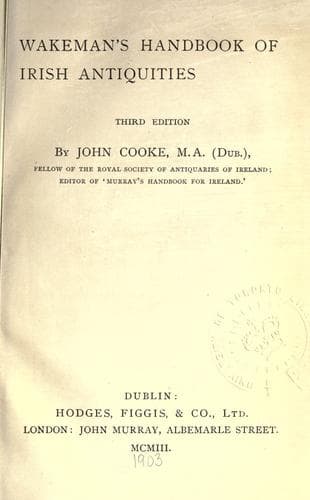
Wakeman's handbook of Irish antiquitiesWakeman, W. F. (William Frederick)
History
Wakeman's handbook of Irish antiquities
Wakeman, W. F. (William Frederick)
Ireland -- Antiquities
The construction of these chambered tumuli, so peculiar to our eyes,
had its origin in the primitive mound-dwelling, survivals of which
are still to be found among the Lapps inhabiting the extreme north of
Scandinavia. Here, as Mr. Arthur Evans points out, ‘are the ring-stones
actually employed in propping up the turf-covered mound of the
dwelling, and there is the low entrance gallery leading to the chamber
within, which, in fact, is the living representative, and at the same
time the remote progenitor, of the gallery of the chambered barrow.’
The bee-hive tombs of Mycenæ are traced back by Professor Adler to
Phrygia. Here, according to Vitruvius, the dwellers in the valleys dug
a circular pit, raised a cone-shaped chamber with posts, covered it
with weeds and branches; over all they piled a heap of earth, and cut
a passage into the chamber from without. Of this Dr. Schuchhardt says:
‘The analogy is certainly significant. Men in all ages have fashioned
the dwellings of the dead in accordance with those of the living; but
the dead are conservative, and long after a new generation has sought a
new home and a new pattern for its houses, the habitations of the dead
are still constructed in ancestral fashion.’[46]
The distribution of the spiral, which is so remarkable a feature at
Newgrange, has in recent years received much attention from European
archæologists. It was used in Egypt at a very early period. Dr.
Flinders Petrie has discovered it on scarabs dating as far back as
the fifth dynasty. It is now thought that the spiral reached Europe
from Egypt northwards through the Ægean. Mr. A. J. Evans has found
it in Crete on scarabs of the twelfth dynasty (2700–2500 B.C.), but
its adoption in Mycenæan ornament from this early wave northward is
doubted. Dr. Petrie considers that the intermediate stages so evident
in Egypt are absent in Greece.[47] Evidence seems to show that its
development in Greece was due to a wave of influence from Egypt during
the eighteenth dynasty (1580–1320 B.C.). In Greek hands it attained the
same degree of perfection as in Egypt, and has been found elaborately
decorating the stelæ, gold ornaments, and vessels in the tombs of
Mycenæ, in the alabaster frieze at Tiryns, and in the slabs of the
ceiling of the tomb at Orchomenos.
Public-domain text, read in full here on John Shaqi.
Reviews
Reviews
No reviews yet
Be the first to share your thoughts on this work.
Elsewhere in the archive
Join the Discussion
Join the discussion
Sign in to leave a comment or review.
Sign InorCreate an account