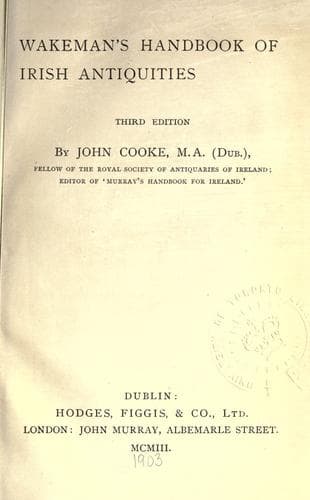
Wakeman's handbook of Irish antiquitiesWakeman, W. F. (William Frederick)
History
Wakeman's handbook of Irish antiquities
Wakeman, W. F. (William Frederick)
Ireland -- Antiquities
Cairn L is 135 feet in diameter, and has a circle of 42 stones set on
edge, varying from 6 to 12 feet in length, and 3 to 4 feet in height.
It is chambered, and the roof fashioned by overlapping stones similar
to that of Newgrange. The passage and chamber have a combined length
of 29 feet, and the latter is 13 feet in width. On the floor of the
passage is a flagstone, measuring 8 feet 9 inches by 3 feet 6 inches;
and in one of these recesses is the largest and best finished stone
basin yet discovered, measuring 5 feet 9 inches by 3 feet 1 inch.
Fragments of pottery to the number of 154 were found, and under the
basin pieces of burnt bone and many human teeth.
Cairn T is the most conspicuous monument of the group; it measures 116
feet in diameter, and rises with sloping sides to a height of 21 feet.
It contains a recessed chamber, like that at Newgrange, in miniature,
the entrance to which faces due east, and is reached by a shallow,
funnel-shaped passage. Round the base is a closely-set circle of 37
stones, varying from 6 to 12 feet in length, and acting as a kind of
retaining fence to the loose, dry boulders which form the body of the
tumulus. One of these stones on the north side is popularly known as
the ‘Hag’s Chair’ (see p. 39). Fergusson states there can be little
doubt that it was intended as a seat, or throne, but by whom it was
raised and for what purpose it is difficult to say. When opened in 1865
the roofing of the passage and much of the chamber had fallen away,
leaving them filled with stones; the combined length is 28 feet, and
the full width of the chamber is 16 feet 4 inches. The floor of the
central octagonal chamber was covered by three large and two small
flags, beneath which were found pieces of burnt bone and charcoal. It
has three recesses, about 4 feet square.
Conwell, without the slightest authority, rushed to the conclusion that
this particular monument must be the tomb of Ollamh Fodhla, and that
the chair cannot be other than the judicial seat, or throne, of that
famous king. He writes: ‘And to whom, keeping in view the preceding MS.
testimony,[45] could this great megalithic chair be more appropriately
ascribed than to Ollamh Fodhla? It would be natural to suppose that,
for the site of the tomb of the great king and law-maker, his posterity
(or, indeed, probably he himself, during his own lifetime) selected the
most elevated spot on the entire range; hence we propose to call the
carn on that spot--904 feet above the sea-level, and situated on the
middle hill--Ollamh Fodhla’s tomb, and the great stone seat “Ollamh
Fodhla’s Chair”; and the ruined remains of the smaller surrounding
cairns, six of which still remain, the tombs of his sons and grandsons,
mentioned in the previous extracts. In fact, on the summit of the
highest hill in the site of this ancient royal cemetery, we believe
there still exist the remains of the tombs of the dynasty of Ollamh
Fodhla’!
Public-domain text, read in full here on John Shaqi.
Reviews
Reviews
No reviews yet
Be the first to share your thoughts on this work.
Elsewhere in the archive
Join the Discussion
Join the discussion
Sign in to leave a comment or review.
Sign InorCreate an account