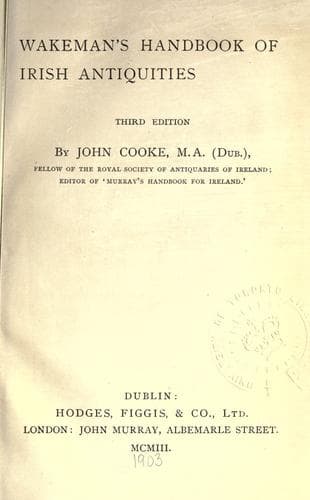
Wakeman's handbook of Irish antiquitiesWakeman, W. F. (William Frederick)
History
Wakeman's handbook of Irish antiquities
Wakeman, W. F. (William Frederick)
Ireland -- Antiquities
_Cairn and Cists at the ‘Barr’ of Fintona._--It is necessary here to
notice a few minor typical yet interesting sepulchres, some of which
it would appear had been left undisturbed and unnoticed until recent
years. One of the most instructive of these occurs at the ‘Barr’ of
Fintona, about three miles north of Trillick, Co. Tyrone. The cairn
was found to consist of a mound of stones, rising to a height of about
8 feet above the then level of the surrounding bog. It was quite
circular in plan. Resting upon the ground, and just within the outer
edge of the pile, were eight cists, each of which had the appearance
of a small cromlech. Four of these chambers enclosed portions of the
human skeleton; and in two of them, in addition to the remains of man,
was found an urn of baked clay. All within the principal urn-bearing
cavity was perfectly dry and undisturbed. The floor was flagged, and
here and there lay human bones in various stages of decomposition. With
them were found three vertebræ of a small mammal, probably those of
a dog. A fine, richly-decorated urn, evidently a food-vessel, lay on
its side in the middle of the enclosure, resting upon a large, clean
slab of sandstone. One of the cists lay on the north-east side of the
mound. It was oblong in form, 2 feet 4 inches in breadth by 3 feet 6
in length. The sides and bottom were neatly flagged. This grave was
reached with difficulty, as it proved to be secured by two ponderous
covering stones, one laid immediately over the other. Upon the floor,
cushioned in damp dust, lay the remains, or portions of the skeletons,
of two human beings, white and clean, as contrasted with the dark-brown
colour of their kindred mould. There were but a few other fragments
of bones beside the crania, and these were removed to the Museum of
the Royal Irish Academy. There were no traces of the lower jaws, nor
even of teeth. From the narrow proportions of the cist, it was quite
manifest that no two perfect human bodies, even those of very young
people, could have been deposited there. The space was far too limited
to have contained even one unmutilated corpse. The bones exhibited
no trace of the action of fire, and were unaccompanied by traces of
charcoal or ashes of any kind. On the mould which lay on the floor
being carefully sifted, no bead, flint-flake, or manufactured article
of any description was discovered; and as the bottom and sides of the
cist were composed of cleanly-split sandstone, it was evident that
nothing but human remains had been entombed there--unless, indeed, we
may suppose that an earthen vessel, or similarly perishable object, had
crumbled into dust amongst the animal matter.
Public-domain text, read in full here on John Shaqi.
Reviews
Reviews
No reviews yet
Be the first to share your thoughts on this work.
Elsewhere in the archive
Join the Discussion
Join the discussion
Sign in to leave a comment or review.
Sign InorCreate an account