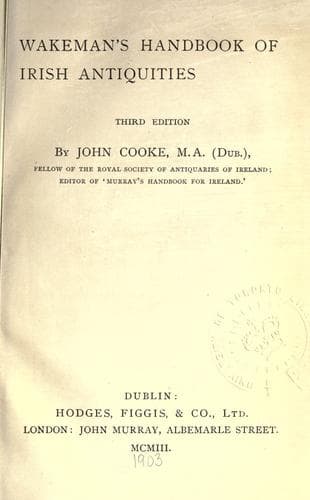
Wakeman's handbook of Irish antiquitiesWakeman, W. F. (William Frederick)
History
Wakeman's handbook of Irish antiquities
Wakeman, W. F. (William Frederick)
Ireland -- Antiquities
At a point in the circumference of the cairn which may be described as
lying south-east from the centre, was a simple cist of quadrangular
form, measuring 17 by 18 inches; its depth was 18 inches. The little
chamber was found to contain some traces of grayish earth, somewhat
like lime-mortar; this occurred here and there in the generally darker
mould, and had the appearance of being a decomposition of human or
other bones. A cavity precisely similar in formation, but somewhat
smaller, lay in the circle, at a distance of about 9 feet from the
cist last noticed. This also yielded nothing of interest. Upon the
north-west side of the cairn were two cists, which in the temporary
absence of the explorer were dug up by treasure-seekers and others.
The havoc here perpetrated by ignorance is greatly to be lamented, as
in one of the cists an ornamental vase had been found, one fragment
of which Mr. Wakeman was fortunate enough to recover. In connection
with this vessel was discovered a beautifully formed flint knife. When
perfect, as originally found, it measured 3-3/10 inches in length,
by 1½ inches at its broadest part. The blade was extremely thin, and
exhibited on one side a central ridge, the other surface being flat
or slightly convex. Like most implements of its class, it presented
admirably chipped edges. The colour was dark-gray, and the instrument
showed no evidence of its having been submitted to the action of
fire. Another grave lay nearly midway between the first described
and the more northern of the two which had been shattered by the
treasure-seekers. It also was in all but utter ruin, owing partly
to the dampness of its position, and perhaps in some degree to the
comparatively inferior material of its component parts. The contents
presented human bones--those of adults--so soft and decomposed as not
to bear the slightest touch. They suggested the idea of softish mortar,
or of putty. No artificial object was here found, though everything
was done to bring to light any deposit which might have accompanied
the bones. A trench was excavated from the northern side through more
than half the diameter of the cairn; but no central cist or chamber was
discovered.[53]
The importance of the discoveries made at the ‘Barr’ in their bearings
upon more than one archæological question will doubtless, by a careful
reader, be acknowledged. Whether the human remains there found,
apparently huddled together in cists not sufficiently large to have
contained an entire adult body, were those of victims immolated during
the celebration of sepulchral rites, or whether they were relics of
persons slain in battle, buried, and subsequently disinterred for final
sepulture in the territory of their people or ancestors, are questions
which it would be very difficult to decide.
* * * * *
Public-domain text, read in full here on John Shaqi.
Reviews
Reviews
No reviews yet
Be the first to share your thoughts on this work.
Elsewhere in the archive
Join the Discussion
Join the discussion
Sign in to leave a comment or review.
Sign InorCreate an account