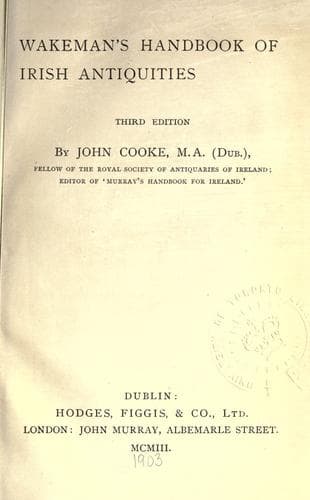
Wakeman's handbook of Irish antiquitiesWakeman, W. F. (William Frederick)
History
Wakeman's handbook of Irish antiquities
Wakeman, W. F. (William Frederick)
Ireland -- Antiquities
A number of small cists were then examined, some fifteen in all, which
lie in the various rays. Most of these diminutive receptacles had
evidently been previously searched. Of the six into which the spade
was introduced, four yielded small pieces of calcined bone, burned
earth and stones, black, greasy clay, and considerable quantities
of charcoal. There was much osseous sediment, resembling gray turf
ashes well moistened with water. The cists had, doubtlessly, all been
originally covered by flags, and would have presented the appearance of
miniature cromlechs. In design they were irregularly circular, composed
of five or more small stones, which in a manner lined the mouth of a
little pit sunk about a foot or so into the ‘till.’ The dimensions of
the largest, and we may say perfect, cist were as follows: 2 feet 2
inches by 2 feet 3 inches; depth, as well as could be ascertained, 2
feet. That they had ever contained urns is highly improbable, as not a
fragment of pottery appeared to reward the search.
‘Horned cairns,’ bearing a general likeness to the Doohat monument,
are also found in the north of Scotland, and were first properly
investigated by Dr. Joseph Anderson, as described in _Scotland in Pagan
Times_ (p. 230). In Scandinavia graves are found of various forms,
triangular, square, oval, and ship-shaped, a description of which
will be found in Fergusson’s _Rude Stone Monuments_ (p. 281), and M.
Du Chaillu’s _Viking Age_ (vol. I., chap. xviii.). Triangular-shaped
graves were generally supposed to be confined to Scandinavia, but
at least one example, as noticed by Colonel Wood-Martin, in _Rude
Stone Monuments of Sligo_ (p. 176), occurs in Ireland, in Northern
Moytura (Moytirra), the scene of the battle between the Fomorians and
the Tuatha De Danaan, seven years after the latter had defeated the
Firbolgs at Southern Moytura, Cong. Sir William Wilde describes some of
the cairns which mark the latter battle-field in his _Guide to Lough
Corrib_ (chap. viii.).
* * * * *
_Mounds._--Mounds of earth, occasionally mixed with stones, were
sometimes erected as places of interment. In England these earthen
mounds are called ‘Barrows’; they partake very much of the character
of cairns, from which class of sepulchre they may be said to differ
only in material, the cairns being entirely of stone. Some interesting
examples may be seen in the immediate vicinity of Dublin, in the
neighbourhood of Clontarf. These have been usually, but we believe
without warrant, associated with the great battle fought on Good
Friday, 1014, in which Brian, the son of Kennedy, commonly called
Brian Boroimhe, or ‘of the Tributes,’ fell in defeating the Danes.
The discovery of a Celtic sepulchral urn in one of these mounds, and
a bronze sword, and other relics of the same material in the tumulus
near ‘Conquer Hill,’ are evidence of an existence long anterior to the
eleventh century.
Public-domain text, read in full here on John Shaqi.
Reviews
Reviews
No reviews yet
Be the first to share your thoughts on this work.
Elsewhere in the archive
Join the Discussion
Join the discussion
Sign in to leave a comment or review.
Sign InorCreate an account