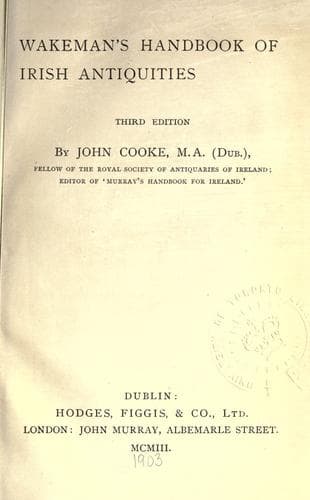
Wakeman's handbook of Irish antiquitiesWakeman, W. F. (William Frederick)
History
Wakeman's handbook of Irish antiquities
Wakeman, W. F. (William Frederick)
Ireland -- Antiquities
Small cairns marking the place of a death, or a halting-place in a
funeral procession, are still raised in some parts of Ireland--a
practice also common among primitive people in other lands. Examples
of cairns raised by devotees at some sacred spot are occasionally to
be met with. The most remarkable instance we know of is that raised by
pilgrims, who add stones to the heap after performing their stations,
at Glencolumbkille, Co. Donegal. It stands high upon the side of the
hill, close to the ruins of the old church, and measures about 30 paces
long, 4 wide, and 5 feet high.
* * * * *
[Illustration: Stones of the Circle at Newgrange.]
_Stone Circles._--Stone circles of great magnitude are to be seen in
many parts of Ireland. Of the lesser kind numerous examples occur in
various counties, and particularly in the north and north-west. They
are invariably composed of rough unhewn blocks, varying in height from
2 to 11 feet, or more, above the level of the adjoining land; and in
some instances they are encompassed with a low earthen mound or ditch.
Their area, though often apparently unoccupied, is generally found to
contain one or other of the remains already described--a cromlech,
a tumulus or cairn, a smaller circle, a pillar-stone, cists. Human
bones, cinerary urns, ashes, weapons, implements or ornaments of bone
or flint, or other objects, are invariably discovered within these
enclosures upon the earth being disturbed. The remains of a cremated
body were sometimes deposited in a cist, with or without an urn to
contain them, and the site marked with a circle of standing stones or a
single pillar. It is difficult now to determine the exact significance
of the stone circle round the mound or burial-place. Aristotle makes
an interesting allusion to the erection of stone circles round
burial sites: ‘Among the Iberians, who are a military people, it is
the custom to set round the tomb of a deceased warrior a number of
obelisks corresponding to the number of enemies he has killed.’[54]
The last resting-place of the dead has, however, at all times been
looked upon as more or less sacred; and Christian burial-places are
especially consecrated for the purpose, and protected from intrusion.
The custom of raising a stone circle round a dolmen or cist containing
burial remains has been a general one; and examples are found as far
off as Syria and Arabia similar to the megalithic structures of the
British Isles. The desire to protect and honour the remains of the
illustrious dead has existed in all lands, and has shown itself in the
production of the most remarkable monuments that the world has known.
The megalithic structures of western Europe, the elaborately decorated
tombs of the Mycenæan Age, the rock-tombs of Etruria, the Egyptian
pyramids, and the magnificent monuments of India abundantly testify to
the respect for the dead in the mind of man everywhere throughout past
ages.
Public-domain text, read in full here on John Shaqi.
Reviews
Reviews
No reviews yet
Be the first to share your thoughts on this work.
Elsewhere in the archive
Join the Discussion
Join the discussion
Sign in to leave a comment or review.
Sign InorCreate an account